
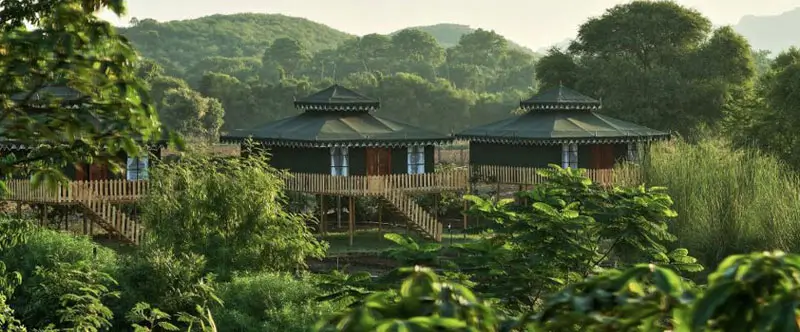
Tourism has long been one of Rajasthan’s greatest strengths — a lifeline for its economy and a window to its culture. But as more travelers arrive each year, the challenge has grown clear: how do we protect the very beauty that draws people here? In Ranthambore, where forests meet farmlands and wildlife coexists with communities, the answer lies in sustainable tourism — a philosophy that Maa Ashapura Boutique Farm embodies with pride and purpose.
This boutique retreat is not just a place to stay; it’s a model for how hospitality can exist in harmony with the land. From solar-powered operations to organic farming, from employing local villagers to preserving Rajasthani traditions, every detail of the farm reflects conscious choices.
At a time when travel is being redefined, Maa Ashapura Farm offers a glimpse of the future — where comfort and conservation go hand in hand.
Before diving into the details, it’s important to understand what sustainable tourism truly means. It’s more than just being eco-friendly; it’s about creating systems that support the environment, empower people, and preserve culture — all while ensuring visitors have meaningful experiences.
In places like Ranthambore, where natural ecosystems and rural communities are closely intertwined, sustainability requires balance. Tourists come for safaris and serenity, but without care, both wildlife and villages suffer from overuse of resources and cultural erosion.
Maa Ashapura Boutique Farm recognizes this balance as sacred. Its entire operation — design, management, and guest experience — revolves around respect for nature and community. The result is a stay that feels pure, purposeful, and peaceful.
The first impression of Maa Ashapura Boutique Farm is its architecture. Unlike conventional hotels that import marble and glass, the farm’s structures are built with locally sourced materials — stone, mud, and lime plaster that blend seamlessly with the landscape.
Walls are thick to maintain natural insulation, minimizing the need for artificial cooling. Roofs are thatched with traditional materials that breathe, keeping interiors cool in summer and warm in winter. Courtyards allow airflow and daylight, reducing dependence on electricity.
Even the furniture and décor are handcrafted by local artisans using reclaimed wood, terracotta, and woven fabrics. The design aesthetic is rooted in the principle of eco-luxury — understated elegance that leaves minimal environmental impact.
The architecture itself becomes a lesson in sustainability — proving that beauty and responsibility can coexist effortlessly.
Ranthambore’s semi-arid climate makes water conservation essential. Maa Ashapura Farm has implemented multiple rainwater harvesting systems that collect and store monsoon rainfall for use throughout the year. Greywater from sinks and showers is filtered naturally and reused for gardening.
The farm also runs partially on solar power, with panels installed across rooftops to supply energy for lighting and heating. This reduces dependence on conventional electricity and lowers carbon emissions significantly.
At night, the property glows softly with solar lamps and candles instead of harsh artificial lights, preserving the natural darkness that local wildlife depends on. Guests often describe the ambiance as “earth-lit” — romantic and responsible at once.
Through these small but impactful steps, the farm demonstrates that sustainability isn’t about sacrifice; it’s about smart design.
At the heart of Maa Ashapura Boutique Farm lies its organic fields — patches of green that feed not only guests but also the soil and community. The farm grows a variety of crops — millets, spinach, tomatoes, herbs, and seasonal vegetables — all without chemical fertilizers or pesticides.
Instead, the soil is nourished using compost made from kitchen waste and natural manure from local cattle. This closed-loop system ensures zero waste and maximum nutrition.
The food served to guests is a reflection of this philosophy — fresh, local, and seasonal. From bajre ki roti to sabzi cooked in mustard oil, every dish celebrates the land it comes from.
Guests are welcome to walk through the fields, pluck their own vegetables, or join the farmers during harvesting. These small interactions build awareness — showing how food grows, how soil breathes, and how communities thrive when they work with nature instead of against it.
This connection between farming and hospitality is what makes the experience deeply authentic.
Sustainability extends beyond ecology — it must also uplift people. Maa Ashapura Boutique Farm serves as a source of livelihood for nearby villages, employing local residents as gardeners, cooks, guides, and maintenance staff.
For many, this isn’t just employment — it’s empowerment. The farm provides training in hospitality, English communication, and eco-management, giving villagers long-term skills that sustain them beyond tourism seasons.
The property also collaborates with women’s self-help groups that produce handicrafts, organic soaps, and pickles sold in the farm’s boutique store. Guests who buy these products directly support rural entrepreneurship.
In this way, every stay contributes to community development — creating a tourism model where benefits circulate locally rather than flowing outward.
Ranthambore is one of India’s most important wildlife habitats, but it’s also under pressure from increasing visitor traffic. Maa Ashapura Farm actively supports responsible tourism practices that protect wildlife rather than disturb it.
The management works closely with local safari operators to ensure ethical safari practices — no chasing animals, no loud noises, and no feeding wildlife. They encourage guests to understand the ecosystem as a delicate balance rather than a spectacle.
Educational workshops are also organized for guests, where naturalists explain how flora, fauna, and rural life depend on one another. Children, in particular, find these sessions eye-opening — learning about tigers, deer, and migratory birds through storytelling and observation.
The farm also contributes to local conservation efforts through donations and awareness campaigns that support reforestation and wildlife monitoring programs.
By aligning tourism with protection, Maa Ashapura Farm ensures that Ranthambore’s wilderness remains alive for generations to come.
Every design decision at Maa Ashapura Boutique Farm supports a larger environmental goal. Pathways are made from natural stone that absorbs heat, preventing the “urban heat island” effect common in concrete resorts.
Gardens are landscaped with native species that require minimal water and attract pollinators like bees and butterflies. Open-air courtyards reduce dependency on air-conditioning, while ceiling fans and natural cross-ventilation maintain comfort efficiently.
Even the waste management system reflects innovation — glass, paper, and metal are recycled, while organic waste returns to the soil as compost.
These invisible design choices add up to visible impact — a property that thrives in harmony with its surroundings rather than depleting them.
Guests at Maa Ashapura Boutique Farm are not treated as passive consumers but as active participants in the sustainability journey. Upon arrival, they receive a warm welcome along with a short introduction to the farm’s eco-practices.
They are encouraged to conserve water, avoid plastic, and use refillable glass bottles provided in the rooms. Guests can also take part in farm walks, tree-planting drives, and village visits to understand the impact of responsible travel firsthand.
Even simple actions like switching off lights, minimizing towel laundry, or choosing local dishes over imported ones become part of a shared effort to protect the planet.
This sense of involvement transforms tourism from a transaction into a relationship — between the traveler, the community, and the environment.
What makes Maa Ashapura Boutique Farm truly exceptional is that it doesn’t limit sustainability to its boundaries. The team actively shares knowledge with nearby resorts and encourages eco-friendly practices across Ranthambore’s tourism circuit.
Workshops on organic farming, rainwater harvesting, and waste management are conducted for local villagers and hoteliers alike. School programs introduce children to environmental care, fostering awareness from a young age.
By leading through example rather than preaching, the farm has quietly inspired others to follow — turning sustainability from an idea into a community movement.
This ripple effect is the true mark of responsible tourism — progress that multiplies instead of isolates.
Across the world, travelers are becoming more conscious of their impact. They want to stay in places that align with their values — clean energy, ethical food, and community inclusion.
In Rajasthan, where natural beauty and cultural richness are intertwined, this shift is not just welcome but essential. The success of places like Maa Ashapura Boutique Farm proves that sustainability is not a limitation — it’s liberation.
It allows destinations to preserve their soul while prospering economically. It gives travelers deeper meaning, not just better comfort. And it ensures that the joy of travel remains possible for future generations.
Ranthambore, with its forests, farms, and fortresses, stands at the heart of this transformation — a symbol of how India’s heritage and environment can thrive together.
Q.1 What makes Maa Ashapura Boutique Farm a sustainable property?
It uses solar energy, rainwater harvesting, organic farming, and local materials to minimize environmental impact.
Q.2 Does the farm support local communities?
Yes, most staff are from nearby villages, and the property partners with women’s groups for craft and food production.
Q.3 Are safaris organized responsibly?
Yes, all safaris follow eco-guidelines ensuring minimal disturbance to wildlife and habitats.
Q.4 Is the food organic?
Absolutely. Most ingredients come directly from the farm’s own organic fields.
Q.5 Can guests participate in sustainability activities?
Yes, guests can join farm walks, tree planting, composting, and cooking with local produce.
Q.6 Does the farm use plastic?
Single-use plastic is avoided entirely; glass bottles and biodegradable materials are used instead.
Q.7 How does the property handle waste?
Waste is segregated, recycled, and composted to maintain a zero-waste system.
Q.8 Is solar power sufficient for the entire resort?
A major portion of the energy is solar-generated, supplemented by efficient conventional systems.
Q.9 Can guests learn about sustainability during their stay?
Yes, guided tours and short sessions explain the eco-initiatives practiced on the farm.
Q.10 Why is Maa Ashapura Farm a model for sustainable tourism in Ranthambore?
Because it harmonizes luxury, ecology, and community — setting a practical and inspiring example for the region.

Stay close to nature at Maa Ashapura Farm – a
boutique retreat near Ranthambore National Park.
Enjoy wildlife safaris, Marwari horse experiences, yoga, nature walks, and
private dining.