
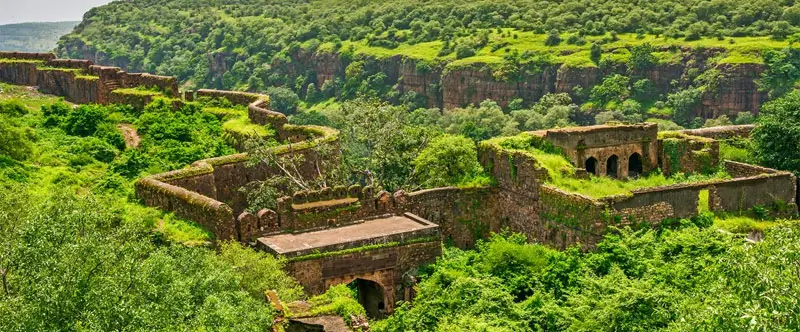
Standing silently above dense forests and winding lakes, Ranthambore Fort is not just a monument of stone and walls. It is a living witness to centuries of political ambition, royal conflicts, spiritual devotion, and nature’s quiet reclamation of human history. What makes Ranthambore Fort truly unique is not only its age or architectural strength, but the extraordinary fact that it exists inside a thriving tiger reserve.
For many visitors, the presence of a medieval fort inside Ranthambore National Park raises a natural question: Why would a massive fort be located deep within a forest that is now protected for wildlife? The answer lies in understanding how geography, power, survival, and nature have always been deeply intertwined in this region.
This detailed guide explores the complete history of Ranthambore Fort, its strategic importance, spiritual role, royal past, and the fascinating reason it now coexists with one of India’s most famous wildlife reserves.
Ranthambore Fort is located on a high rocky plateau overlooking a vast forested landscape. Long before the area was declared a national park, this geography made the location extraordinarily valuable. Elevated terrain offered clear visibility over surrounding regions, natural defense from invaders, and access to water bodies within the fort’s boundaries.
The surrounding forest was never considered wilderness in the modern sense. It functioned as a natural buffer zone, protecting the fort from enemy armies while providing resources such as water, timber, and game. This combination of defense and sustenance made Ranthambore an ideal stronghold for ruling dynasties.
The origins of Ranthambore Fort trace back over a thousand years. It was initially established by early Rajput rulers who recognized the strategic value of the location. Over time, it became one of the most important forts in Rajasthan.
Ranthambore was not merely a military installation. It was a self-contained city. Within its walls lived royal families, soldiers, administrators, artisans, priests, and traders. Temples, stepwells, palaces, and residential structures formed a complete ecosystem.
This self-sufficiency explains why the fort could withstand prolonged sieges, some lasting months.
The fort reached its peak significance under the Chauhan rulers, particularly during the reign of Prithviraj Chauhan and his ancestors. For the Chauhans, Ranthambore was more than a fort; it was a symbol of authority and resistance.
Multiple invasions targeted Ranthambore due to its strategic location. Control over the fort meant control over important trade routes connecting northern and central India. As a result, Ranthambore became a frequent battleground between Rajput kings and invading forces.
Each invasion left physical and cultural marks on the fort, shaping its architecture and layout.
Ranthambore Fort witnessed several major sieges involving powerful rulers, including the Delhi Sultanate and later the Mughal Empire. One of the most famous sieges occurred under Alauddin Khilji, who recognized the fort’s strategic importance.
These conflicts were brutal and prolonged. The surrounding forests played a crucial role during sieges, acting as both a shield and a supply challenge. Control over water reservoirs within the fort often determined the outcome of battles.
Eventually, repeated conflicts weakened royal control, and political power shifted away from Ranthambore.
Beyond warfare, Ranthambore Fort has deep spiritual importance. Several ancient temples exist within the fort complex, reflecting centuries of uninterrupted worship.
The most revered is the Trinetra Ganesh Temple, one of the oldest temples dedicated to Lord Ganesha. Unlike typical depictions, this temple features Ganesha with three eyes, symbolizing supreme awareness.
Pilgrims from across Rajasthan and beyond continue to visit the temple, even today. This uninterrupted spiritual presence is one of the reasons the fort never became completely abandoned.
Historical records and architectural remains suggest that life inside Ranthambore Fort followed a structured rhythm. Water management systems, including stepwells and reservoirs, ensured survival during dry seasons.
Markets, temples, and residential quarters created a functioning urban center. The surrounding forests provided hunting grounds for royalty, but also served as ecological support systems.
This coexistence of human settlement and forest life laid the foundation for the region’s future transformation.
As political power shifted and newer forts gained prominence, Ranthambore gradually lost its strategic importance. Royal families moved out, military relevance declined, and maintenance reduced.
Nature began reclaiming the area. Vegetation grew around abandoned structures. Wildlife returned to spaces once dominated by human activity. Unlike many forts that were repurposed or destroyed, Ranthambore was left largely untouched.
This abandonment allowed the fort to merge slowly with its natural surroundings.
During the twentieth century, the forests surrounding Ranthambore were recognized for their ecological value. Tigers, leopards, and diverse wildlife thrived in the region.
Instead of removing historical structures, conservation planners made a rare decision: preserve both heritage and wildlife together. This approach led to the creation of Ranthambore National Park with the fort at its heart.
The fort’s presence actually benefited conservation. Restricted human activity around historical structures created safe zones for wildlife.
Unlike other forts that sit outside protected areas, Ranthambore Fort remains inside the park because it was never separated from its natural environment. The forest grew around the fort, not the other way around.
Removing the fort would have damaged both heritage and ecology. Preserving it maintained the historical narrative of coexistence between humans and nature.
Today, the fort stands as a reminder that landscapes are shaped by time, not single-purpose planning.
Tigers, leopards, and other animals frequently move near the fort walls. Water bodies around the fort attract wildlife, especially during dry months.
This creates a rare visual contrast: ancient stone structures surrounded by living wildlife. Few places in the world offer such a blend of history and nature.
Visitors often observe wildlife resting near ruins, reinforcing the idea that nature eventually reclaims all human constructs.
Local communities view Ranthambore Fort not just as a tourist attraction, but as part of their cultural identity. Stories, legends, and spiritual traditions are deeply tied to the fort.
The Trinetra Ganesh Temple remains a center of faith, ensuring continued cultural relevance.
This living connection distinguishes Ranthambore Fort from purely archaeological sites.
The fort represents an early example of integrated conservation, where history and ecology coexist. Modern conservation increasingly values such integrated landscapes.
Ranthambore demonstrates that preserving human heritage does not necessarily conflict with wildlife protection when managed thoughtfully.
Access to the fort is regulated to ensure both safety and preservation. Visitors must respect rules designed to protect wildlife and historical structures alike.
Walking through the fort offers panoramic views of the park, reinforcing the scale and richness of the surrounding ecosystem.
Understanding the fort’s history adds depth to wildlife safaris. Tigers moving near ancient ruins remind visitors that nature outlasts empires.
This perspective transforms a safari from a sightseeing activity into a reflection on time, power, and resilience.
Ranthambore Fort symbolizes coexistence between humans and nature across centuries. It stands not as a relic of domination, but as evidence of adaptation.
Few places illustrate this balance as powerfully.
In a world where development often erases history, Ranthambore Fort shows that preservation and protection can work together.
It continues to educate, inspire, and remind visitors of humanity’s place within nature.
Frequently Asked Questions
Why is Ranthambore Fort located inside a national park
Because the forest grew around the fort over centuries, making separation impractical.
Who built Ranthambore Fort
It was built and expanded by early Rajput rulers, especially the Chauhan dynasty.
Is Ranthambore Fort older than the national park
Yes, the fort predates the park by several centuries.
Can visitors see wildlife near the fort
Yes, wildlife frequently moves around the fort area.
Is Ranthambore Fort a UNESCO site
It is part of a UNESCO World Heritage listing under Hill Forts of Rajasthan.
Is the Trinetra Ganesh Temple still active
Yes, it remains an active place of worship.
Did tigers live here during royal times
Yes, the forest supported wildlife even during royal occupation.
Was the fort ever completely abandoned
No, spiritual activity continued even after political decline.
Does the fort affect wildlife movement
It has become part of the natural landscape, not a barrier.
Why is Ranthambore Fort important today
It represents the rare coexistence of heritage and wildlife conservation.

Stay close to nature at Maa Ashapura Farm – a
boutique retreat near Ranthambore National Park.
Enjoy wildlife safaris, Marwari horse experiences, yoga, nature walks, and
private dining.