
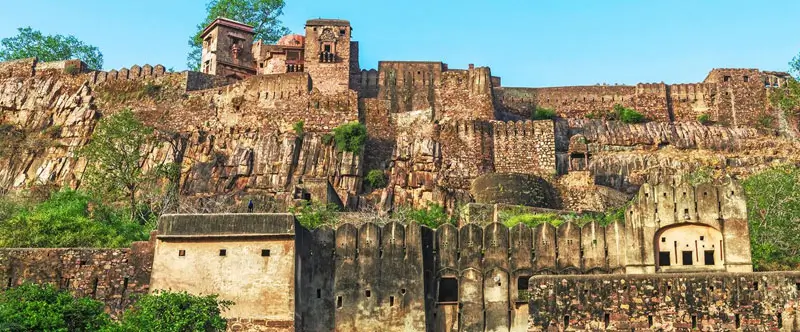
When travelers think of Ranthambore, most imagine the thrilling tiger safaris and encounters with wild animals in the heart of Rajasthan’s forests. Yet, there is another treasure hidden within the park that is equally captivating — the Ranthambore Fort. Perched on a 700-foot-high hill inside Ranthambore National Park, this ancient fort is a UNESCO World Heritage Site and a living symbol of Rajasthan’s royal past. The fort blends history, spirituality, and architecture against the backdrop of a wild jungle where tigers still roam. For visitors, a trip to Ranthambore is incomplete without exploring this fortress that has stood tall through centuries of battles, legends, and dynasties. More than a historical monument, Ranthambore Fort is an experience where heritage and wilderness meet.
Ranthambore Fort’s origins date back nearly a thousand years. Historians believe it was first constructed in the 10th century by the Chauhan dynasty, who were among the most powerful rulers of Rajasthan. Some accounts credit King Sapaldaksha as the founder of the fort. Over time, Ranthambore Fort became a prized possession for various rulers due to its strategic location between North and Central India. It was not just a military stronghold but also a symbol of Rajput pride. Throughout history, the fort changed hands between the Chauhans, Delhi Sultans, Mughals, and later the Maharajas of Jaipur. Each ruler left behind architectural and cultural imprints, making the fort a unique blend of Rajput valor and Mughal influence.
The fort’s location on a massive hilltop inside a dense forest gave it a natural defense system. Surrounded by the rugged terrain of the Aravalli and Vindhya ranges, it overlooked fertile plains and trade routes. Whoever controlled Ranthambore Fort had control over the region’s economy and military movements. For centuries, it was considered impregnable and was often the center of fierce battles. In fact, the fort was attacked multiple times by invaders including Alauddin Khilji in the 13th century and the Mughal emperor Akbar in the 16th century. Despite numerous sieges, the fort’s reputation as a symbol of Rajput courage and sacrifice grew stronger.
The architecture of Ranthambore Fort is a blend of Rajput military design and later Mughal influences. The fort is spread across nearly 7 kilometers of ramparts and walls, with massive gateways, temples, palaces, and stepwells inside. The high stone walls are built to withstand invasions and are punctuated with bastions that once held cannons and archers. There are seven main gates, including the popular Suraj Pol (Sun Gate), Padal Pol, and Ganesh Pol, each built to protect against enemy advances. Inside the fort, visitors will find ruined palaces, cenotaphs, and reservoirs that give a glimpse into its past glory. One of the most striking features is the integration of the fort with its natural surroundings — ancient trees grow alongside stone walls, and langurs roam freely among the ruins. The combination of nature reclaiming man-made structures gives Ranthambore Fort a haunting beauty that photographers love to capture.
One of the most remarkable aspects of Ranthambore Fort is its collection of ancient temples, many of which are still active places of worship. The most famous is the Trinetra Ganesh Temple, dedicated to Lord Ganesha. It is unique because it depicts Ganesha with three eyes, and it attracts devotees from across India. According to legend, this temple was built by King Hammir Dev Chauhan in the 13th century. Every year during Ganesh Chaturthi, thousands of pilgrims gather here, turning the fort into a lively celebration. Apart from the Ganesh temple, the fort houses temples dedicated to Shiva, Ramlalaji, and Kalika Mata. These temples add a spiritual dimension to the fort, making it not just a military monument but also a sacred space.
Ranthambore Fort is steeped in stories of bravery, sacrifice, and devotion. One of the most famous tales is that of King Hammir Dev Chauhan, who ruled during the 13th century. Faced with the invasion of Alauddin Khilji’s army, Hammir Dev is remembered for his courage and refusal to surrender. Legends also speak of “Jauhar,” the Rajput tradition where women performed mass self-immolation to protect their honor when defeat was imminent. These stories, though tragic, highlight the Rajput ethos of valor and sacrifice that defines Rajasthan’s history. Visitors walking through the fort often feel the echoes of these tales in its silent walls and ruins.
What makes Ranthambore Fort unique is its setting inside a tiger reserve. The ruins are often surrounded by wildlife — langurs, peacocks, deer, and sometimes even leopards or tigers near the base of the hill. For birdwatchers, the fort is an excellent spot to see owls, vultures, and parakeets. From the top of the fort, panoramic views stretch across the national park, where lakes shimmer and forests spread endlessly. The fusion of heritage and wilderness makes this fort unlike any other historical site in India.
Visiting Ranthambore Fort is more than just a historical excursion; it’s a journey into a living ecosystem of history and nature. Tourists can start by entering through the main gate and exploring the old pathways that lead to temples, palaces, and vantage points. A must-do is attending the daily prayers at the Trinetra Ganesh Temple, where locals still carry forward traditions centuries old. Walking through the ruins of Hammir’s Palace, one can imagine the grandeur of Rajput courts. Photography lovers will enjoy capturing the merging of stone walls with banyan roots and monkeys playing against the backdrop of ancient steps. At sunset, the fort’s ramparts offer breathtaking views of Padam Talab and the forest below, often with herds of deer grazing in the golden light. The fort also provides a chance to learn about the cultural history of Rajasthan, making it a perfect complement to the wildlife safaris.
The fort is located inside Ranthambore National Park, about 11 km from Sawai Madhopur railway station. Visitors usually hire a private driver in Ranthambore or join guided tours to reach the fort. Entry is allowed with a small fee for Indian and foreign tourists. The climb up to the fort involves a moderately steep walk, but the views and experiences are worth the effort. It is advisable to visit in the morning or late afternoon when temperatures are cooler.
Like the national park, the fort can be visited from October to June. Winters (October to March) are the most comfortable for exploring, while summers (April to June) can be hot but less crowded. Monsoon months (July to September) are not ideal due to rain and slippery paths. For photography, early morning and evening provide the best light conditions.
Ranthambore Fort is more than a structure of stone; it is a witness to Rajasthan’s history, bravery, and cultural richness. For foreign tourists, it provides a chance to connect with India’s medieval heritage while also experiencing the unique blend of wildlife and history. Unlike other forts of Rajasthan, Ranthambore offers the added thrill of being located in a tiger reserve, where the past and the present coexist in dramatic ways. Visiting Ranthambore Fort is not just sightseeing — it’s a journey through time, faith, and wilderness.
Q1: Who built Ranthambore Fort?
The Chauhan dynasty, around the 10th century.
Q2: Why is Ranthambore Fort famous?
It is a UNESCO World Heritage Site known for its Rajput history and temples.
Q3: What is the most famous temple inside the fort?
The Trinetra Ganesh Temple, dedicated to Lord Ganesha.
Q4: How high is Ranthambore Fort?
About 700 feet above the surrounding forest.
Q5: Do tourists need a safari ticket to visit the fort?
No, the fort has a separate entry route accessible by road.
Q6: Can tigers be seen near the fort?
Yes, sometimes tigers and leopards are spotted near its base.
Q7: How much time does it take to explore the fort?
Around 2–3 hours for a detailed visit.
Q8: What is the best time of day to visit?
Morning and evening are ideal due to cooler weather and better views.
Q9: Is the fort suitable for families with children?
Yes, but the climb can be tiring for very young children.
Q10: Why is it unique compared to other forts in Rajasthan?
Because it lies inside a national park, blending history with wildlife.

Stay close to nature at Maa Ashapura Farm – a
boutique retreat near Ranthambore National Park.
Enjoy wildlife safaris, Marwari horse experiences, yoga, nature walks, and
private dining.