
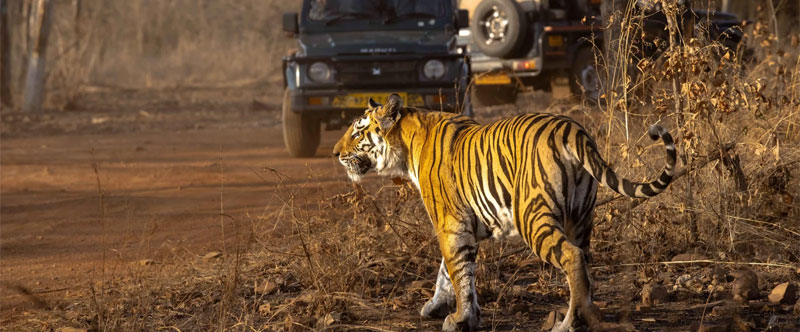
Udaipur and Ranthambore represent two very different sides of Rajasthan. Udaipur is shaped by lakes, palaces, historic streets and the Aravalli landscape, while Ranthambore is associated with dry forest, rocky ridges, ancient ruins and one of India's most recognised tiger reserves. Travelling between the two is therefore a natural choice for visitors who want Rajasthan's architectural heritage and wildlife within the same journey.
The Udaipur to Ranthambore distance by road is approximately 390 kilometres, depending on the starting point in Udaipur and the location of your accommodation around Sawai Madhopur and Ranthambore. A straightforward private-car journey generally requires around 6 to 7½ hours, but travellers should allow additional time for meals, road conditions and local traffic. Current route estimates place the road distance at about 389 kilometres.
Train travel is also practical. The railway destination visitors should search for is Sawai Madhopur Railway Station (SWM) rather than simply entering Ranthambore. Current railway listings show services between Udaipur City and Sawai Madhopur, including a daily Mewar Express connection, although schedules and operating days must always be checked for the actual travel date.
Choosing between road and rail depends on more than fare. A family with luggage may value a private vehicle, while a couple can save substantially by taking a reserved train. Safari timings matter as well: arriving several hours late can mean losing a valuable forest drive.
The distance from Udaipur to Ranthambore is close to 390 kilometres by road. This makes the transfer substantial enough to occupy most of a day once hotel checkout, food stops and the final drive to your accommodation are included.
A navigation application may show a driving time close to six hours under favourable conditions. That should be treated as uninterrupted driving time rather than a guaranteed hotel-to-hotel journey. A realistic allowance of 6 to 7½ hours is more comfortable. A lunch stop, roadworks, urban traffic or a slower final section can extend it further.
The starting point also matters. A hotel beside Lake Pichola and a property on Udaipur's outskirts will produce different departure times. The same applies at the other end because Ranthambore accommodation is spread across Sawai Madhopur and the roads leading toward different sides of the reserve.
An early departure works particularly well. Leaving Udaipur around 7:00 AM after breakfast can provide enough time to reach the Ranthambore area during the afternoon without turning the transfer into a race.
That schedule is considerably safer than attempting an afternoon safari immediately after the drive.
Ranthambore safari hours vary with daylight. Common seasonal schedules place morning drives roughly between 6:00 or 7:00 AM and 9:30 or 10:30 AM, while afternoon drives may begin between approximately 2:00 and 3:30 PM. A road delay of even an hour can therefore be enough to disrupt a same-day afternoon booking.
A comfortable schedule is to use the arrival day for check-in and rest, followed by a Ranthambore morning safari the next day.
Travellers taking a train should think similarly. A service that arrives at Sawai Madhopur after midnight may look efficient because it saves daytime hours, but reaching a hotel in the early morning and waking again for a safari can be exhausting.
The best journey is not necessarily the one with the shortest advertised travel time. It is the one that gets you to Ranthambore rested and comfortably ahead of your first safari.
From the elegance of Udaipur to the untamed landscapes of Ranthambore, make the journey part of the experience. Allow yourself the time to arrive comfortably.
A private car is one of the easiest ways to complete the Udaipur to Ranthambore road trip because it provides hotel-to-hotel transport and control over departure time.
Road routing can vary with live navigation and current conditions. The journey generally crosses Rajasthan from the Udaipur region toward the Sawai Madhopur side, with route selection influenced by road quality, traffic and ongoing works. Drivers may use corridors through areas such as Chittorgarh and Bundi/Kota depending on the selected route and conditions on the day.
Travellers should use current navigation rather than relying on an old printed route. The fastest road on one visit may not remain the best option after construction or traffic changes.
The journey itself can be made comfortable with one substantial break.
Chittorgarh is a tempting stop because of its historic significance, but Chittorgarh Fort is not a twenty-minute roadside attraction. A meaningful visit can consume several hours. Travellers adding it should accept that the journey becomes a sightseeing day rather than a simple transfer.
Bundi can also be appealing for travellers interested in Rajasthan's smaller historic cities. Again, it is better treated as an overnight destination or deliberate extended stop rather than something squeezed between Udaipur and a fixed safari reporting time.
For a direct transfer, stopping for breakfast, coffee or lunch is sufficient.
Private road travel becomes particularly attractive for families. There is no need to move suitcases between hotel, station and train, and rest stops can be taken when necessary. Photographers also benefit because camera bodies and large telephoto lenses can remain safely within reach.
Vehicle selection should match luggage rather than passenger count alone. Four adults with four large suitcases will usually be more comfortable in an SUV or MPV than a compact sedan.
The Udaipur to Ranthambore travel time by car also makes driver quality important. A professional intercity driver familiar with Rajasthan roads is worth paying for. The cheapest quotation should not automatically win if it involves an unsuitable vehicle or unclear charges.
Travellers should confirm air conditioning, tolls, parking, driver allowance and whether the quoted fare is a genuine one-way transfer.
Train travel can provide excellent value on this route.
The main destination is Sawai Madhopur Railway Station, station code SWM. Udaipur City Railway Station uses the code UDZ.
Current railway listings show multiple services on the broader Udaipur City–Sawai Madhopur corridor, although not every train operates every day. The Mewar Express is particularly useful because it is listed as a daily service, departing Udaipur City in the evening and reaching Sawai Madhopur after midnight. Current listings place that journey at just under seven hours.
Other listed services can take approximately six and a half hours to more than ten hours depending on the train and operating day. This difference is important. Selecting a train based solely on ticket price can result in several unnecessary hours of travel.
Indicative railway fares also vary significantly by class. Current Mail/Express base-fare information for the approximately 377-kilometre railway distance lists Sleeper around ₹235, AC 3 Tier around ₹630, AC 2 Tier around ₹900 and First AC around ₹1,510 before considering the exact train, reservation charges or other applicable differences. Live booking platforms can show higher totals; for example, current listings for particular services show AC fares above those base amounts.
Travellers should therefore treat Udaipur to Sawai Madhopur train fare as dynamic rather than expecting one permanent price.
For tourists carrying luggage, reserved air-conditioned accommodation is generally more comfortable. AC 3 Tier often provides a useful balance between price and comfort for a longer journey, while AC 2 Tier offers additional space and privacy.
The major disadvantage is arrival timing.
An overnight service arriving around 1:00 or 2:00 AM requires a confirmed transfer from Sawai Madhopur station. Do not arrive at that hour assuming transportation to a remote accommodation will automatically be convenient.
Arrange pickup before boarding the train and send the property or driver the correct train details.
If the next morning includes a safari, consider the sleep you will lose. A train arriving after 1:00 AM followed by hotel transfer and a wake-up call around 5:00 or 6:00 AM can make the forest drive unnecessarily tiring.
In that situation, travelling one day earlier can be a better decision than choosing the fastest-looking itinerary.
A Udaipur to Ranthambore taxi is the most straightforward choice for travellers who value flexibility and door-to-door comfort.
Pricing depends on the vehicle, pickup location, one-way policy, tolls, season and whether the operator charges for the driver's return journey.
For budgeting on the safer, higher side, a private sedan can reasonably be allowed approximately ₹7,500–₹11,000 for a one-way transfer. A larger SUV or MPV can fall around ₹10,000–₹15,000 or more, while premium vehicles can exceed these ranges.
These are practical budgeting estimates rather than government-fixed tariffs.
Before paying a deposit, ask for a written total that specifies whether tolls, parking, taxes and driver allowance are included.
The difference becomes important on an intercity transfer. A quote of ₹8,000 that excludes multiple charges may ultimately cost more than an all-inclusive ₹9,000 offer.
Vehicle condition also matters on a journey approaching 400 kilometres. Confirm air conditioning and sufficient luggage capacity. Travellers visiting during hotter months should not compromise on a properly functioning AC system merely to reduce the fare.
For three or four passengers, the cost per person becomes more reasonable. The convenience can justify the difference compared with purchasing train tickets and paying separately for transfers at both ends.
Private road travel is also useful for visitors who have spent several days sightseeing in Udaipur and want a less structured transfer day. Departure can be adjusted around breakfast and hotel checkout rather than a fixed railway schedule.
The most important caution is not to schedule the vehicle too late if the following morning includes a tiger safari in Ranthambore. Arriving at midnight after seven or eight hours on the road is possible, but it is rarely the most enjoyable way to begin a wildlife stay.
There is no single transport option that suits everyone.
For a solo traveller, rail usually wins on price. Even an air-conditioned reserved ticket can cost a fraction of a private taxi.
For a couple, the train remains financially attractive, particularly when the timetable fits comfortably with hotel check-in.
For three or four adults, a taxi becomes more competitive because the cost is divided across the group. It also removes station transfers and luggage handling.
Families travelling with children often benefit from a private vehicle because food and washroom stops can happen when required.
Older travellers may prefer either AC rail travel or a comfortable SUV depending on mobility and tolerance for a long road journey.
Wildlife photographers carrying expensive equipment should think carefully about luggage space. A private vehicle allows camera bags to remain accessible and avoids repeatedly loading equipment through stations.
International visitors following a Rajasthan wildlife itinerary may also prefer a private transfer because it creates a seamless connection between Udaipur and their Ranthambore accommodation.
The timetable ultimately matters more than the theoretical advantages.
A perfectly timed train can be better than seven hours in a car. A badly timed train arriving after midnight can be worse than paying extra for a daytime private transfer.
Compare the complete journey: hotel departure, station reporting, railway travel, arrival, final transfer and sleep before safari. That provides a more realistic answer than comparing only the ticket price.
Your Ranthambore safari deserves more than a last-minute arrival. Plan your Udaipur transfer wisely, allow time for the road and settle in before entering the wilderness.
The purpose of travelling this route is usually not merely to reach Sawai Madhopur. Most visitors are coming for Ranthambore National Park, which means the safari schedule should shape the transfer.
Rajasthan Tourism advises visitors to reserve in advance because of the park's popularity and identifies Sawai Madhopur as the key access point for the destination.
Safari drives typically last around three to three and a half hours, and tourism is organised across ten zones. Vehicles operate within allocated zones rather than freely moving across the entire reserve.
That makes punctual arrival important.
If your safari is in the morning, stay in Ranthambore the previous night. If your transfer from Udaipur reaches the destination during the afternoon, keep that evening free.
A two-night stay allows one or two safari opportunities but can still feel compressed. Three nights provide more flexibility for travellers who want multiple drives, wildlife photography and time to recover from the long journey.
Tiger sightings are never guaranteed. Taking more than one safari reduces the pressure placed on a single forest drive.
Keep the identification document associated with your safari reservation accessible. Confirm pickup or reporting arrangements with the relevant operator before sleeping.
Ranthambore's main tourism season operates around forest schedules and seasonal access rules, and current Rajasthan Tourism information identifies October through June as the principal park period.
Travellers should always check current forest conditions and permit rules before fixing non-refundable transport.
The combination works especially well because the destinations contrast rather than compete.
Spend sufficient time in Udaipur for its palaces, lakes and surrounding heritage, then reserve most of a day for the transfer to Ranthambore.
After arrival, keep the evening quiet. A morning safari the following day introduces a completely different Rajasthan: early light over dry forest, deer alarm calls, lakes, rocky terrain and the possibility of seeing a tiger moving through its natural territory.
A second safari can be taken that afternoon or the next morning.
After Ranthambore, Jaipur is a practical onward destination for many visitors. Others continue toward Agra or Delhi. This makes Udaipur to Ranthambore by road particularly useful within a longer Rajasthan and North India circuit.
The transfer should never be treated as wasted time. It is the geographical transition between two landscapes that define very different parts of Rajasthan.
Keep the day realistic, choose transport according to comfort rather than only price, and reach Ranthambore with enough energy left to appreciate the reason you travelled nearly 400 kilometres in the first place.
The Udaipur to Ranthambore road distance is approximately 390 kilometres, depending on the exact starting point, road route and accommodation location. Current route estimates place it at about 389 kilometres.
Allow approximately 6 to 7½ hours for a practical road journey. Stops, traffic, roadworks and the final hotel location can increase the total time.
Yes. Travellers should search for Udaipur City to Sawai Madhopur trains. Current listings show several services on the route, with operating days varying.
Sawai Madhopur Railway Station (SWM) is the principal railway station used by visitors travelling to Ranthambore National Park.
Depending on the service, current listings show journeys ranging from roughly 6½ hours to more than 10 hours. The daily Mewar Express is listed at just under seven hours.
Fare varies by train and class. Indicative base fares range from a few hundred rupees in Sleeper to above ₹1,500 in First AC, while live reservation totals can be higher depending on the selected service and booking conditions.
A practical higher-side allowance is approximately ₹7,500–₹11,000 for a sedan and ₹10,000–₹15,000 or more for an SUV or MPV, depending on the operator and inclusions.
It is possible with a very early departure, but it creates unnecessary risk. Road delays could cause you to miss the reporting time. Arriving first and taking a safari the following morning is more comfortable.
Two nights are workable, while three nights in Ranthambore provide better flexibility for multiple safari drives and a less rushed stay.
Train offers stronger value for solo travellers and couples. A private Udaipur to Ranthambore transfer is generally more convenient for families, groups, photographers and travellers carrying substantial luggage.
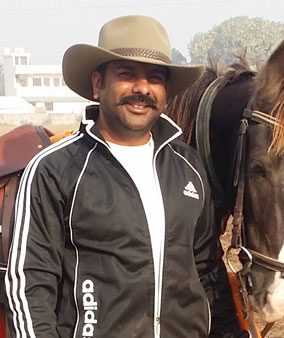
Stay close to nature at Maa Ashapura Farm – a
boutique retreat near Ranthambore National Park.
Enjoy wildlife safaris, Marwari horse experiences, yoga, nature walks, and
private dining.