
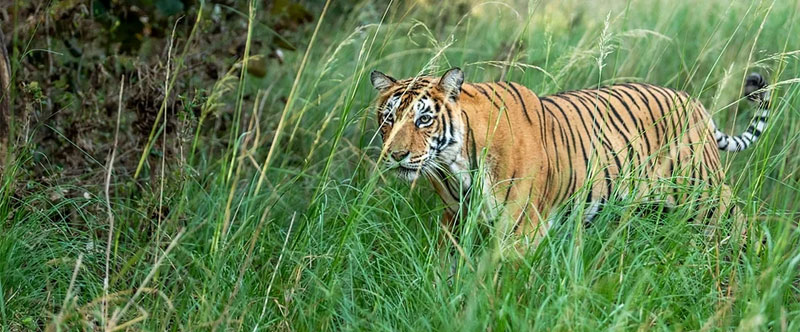
Pushkar and Ranthambore fit naturally into the same Rajasthan journey because they offer completely different settings without requiring an extreme transfer. Pushkar is centred around its lake, ghats, temples, cafés and the dry Aravalli landscape, while Ranthambore brings travellers into a wildlife environment of forests, lakes, rocky ridges, old stone structures and tiger territory.
The Pushkar to Ranthambore distance by road is approximately 270 to 310 kilometres, depending on the selected route and the exact location of the accommodation around Sawai Madhopur. A realistic road transfer usually requires around 5 to 6½ hours, including normal traffic and a short break.
Pushkar does not have a major railway station serving long-distance trains. Travellers who prefer rail generally need to reach Ajmer Junction (AII) first, approximately 15 kilometres from Pushkar, and then take a suitable train toward Sawai Madhopur Junction (SWM).
For couples, families and international visitors carrying luggage, a Pushkar to Ranthambore taxi is often the easiest option because it removes the additional transfer through Ajmer. Train travel can be considerably cheaper, particularly for solo travellers.
The distance is manageable within one day, but safari timing deserves attention. An afternoon forest drive should never depend on the shortest possible road estimate. Reaching Ranthambore the previous afternoon or evening and taking a safari the following morning creates a much more comfortable schedule.
The distance from Pushkar to Ranthambore is best treated as a range rather than one permanent number.
Road routing can change according to traffic, construction and the exact destination entered into navigation. A hotel in Sawai Madhopur and a countryside property closer to the Ranthambore tourism area can produce different total distances.
For practical purposes, travellers should budget approximately 270–310 kilometres.
Driving normally requires around 5–6½ hours. A navigation application may occasionally show a faster journey, but that should not be used as a guaranteed arrival time.
Leaving Pushkar early provides the most comfortable transfer.
A departure around 7:00 AM allows travellers to clear the local area before the day becomes busy. With a breakfast or refreshment stop, reaching Ranthambore around early afternoon is reasonable under ordinary road conditions.
This creates enough time to check in, have lunch and rest.
Attempting a same-day afternoon Ranthambore safari is possible only when the permit timing leaves a generous safety margin. It should not be attempted with a schedule that depends on every road section being clear.
Safari entry times change with daylight. During shorter winter days, afternoon drives can begin relatively early. Arriving fifteen minutes after the required reporting time may mean losing the safari entirely.
The morning safari presents no such problem when visitors arrive the previous day.
This is why the most comfortable Pushkar to Ranthambore travel itinerary uses the transfer day only for travel and keeps the forest for the following morning.
Turn your Pushkar to Ranthambore journey into a seamless part of your Rajasthan experience. After exploring Pushkar’s timeless charm, arrive at Maa Ashapura Farm for unhurried days.
A practical road journey generally moves from Pushkar toward the Ajmer–Kishangarh side before continuing east across Rajasthan toward the Sawai Madhopur region. Depending on live conditions, navigation may direct the vehicle through corridors associated with Tonk or other regional connections.
Road construction and traffic can alter the fastest route, so current navigation should be used on the actual travel day.
The first section between Pushkar and Ajmer/Kishangarh can involve local traffic. After that, longer highway sections make progress easier, although regional roads closer to the destination can be slower.
The Pushkar to Ranthambore road trip does not require an overnight stop. One good meal or tea break is generally enough.
Travellers should resist the temptation to add several attractions simply because they appear close to the route on a map.
A five-hour transfer can easily become an eight-hour day once sightseeing, parking and meals are added.
If an additional city is important, stay there overnight rather than compressing it between Pushkar and a fixed safari.
Self-driving visitors should start with sufficient fuel and check tyre pressure before departure. A properly inflated spare tyre, FASTag balance where applicable, phone charger and drinking water are simple but useful precautions.
During warmer periods, the middle of the day can become extremely hot. A properly functioning air-conditioning system is therefore important.
Winter road travel is more comfortable during the day, although early morning visibility can occasionally be affected by fog in parts of North India.
A professional intercity driver is worth considering for travellers unfamiliar with Rajasthan roads.
A private taxi from Pushkar to Ranthambore offers the simplest door-to-door journey.
The driver can collect passengers directly from a hotel in Pushkar and drop them at their accommodation around Sawai Madhopur or Ranthambore. There is no need to travel to Ajmer Junction, handle luggage at a station or arrange another vehicle after arriving.
For budgeting conservatively, a one-way sedan can be estimated at approximately ₹5,500–₹8,000. A larger SUV or MPV may cost around ₹7,500–₹11,000 or more.
Premium vehicles, holiday demand and last-minute arrangements can push the price higher.
These figures are budgeting ranges rather than fixed tariffs.
Before confirming the booking, request the total Pushkar to Ranthambore taxi fare and ask whether tolls, parking, state taxes and driver allowance are included.
Some operators calculate a minimum daily distance or charge return kilometres even for a one-way transfer. A low advertised per-kilometre rate can therefore be misleading.
For two travellers, a sedan generally provides sufficient comfort unless they are carrying large amounts of luggage.
For four adults, an SUV or MPV is preferable. Four large suitcases can occupy more space than expected, and several hours in a cramped vehicle can make the journey tiring.
Wildlife photographers should consider luggage space carefully. Long telephoto lenses, camera backpacks and tripods are better kept inside the passenger area rather than underneath heavy suitcases.
A private taxi becomes increasingly attractive when three or four people share the cost.
There is no major long-distance railway station in Pushkar comparable with Ajmer Junction.
Travellers using rail should first complete the Pushkar to Ajmer transfer, which is roughly 15 kilometres and normally takes around 30–45 minutes depending on traffic and pickup location.
From Ajmer Junction (AII), travellers can search for trains to Sawai Madhopur Junction (SWM).
Direct services may operate depending on the travel day, while other timings can require different railway arrangements. Current Indian Railways information should always be checked before booking because operating days and schedules can change.
The Ajmer-to-Sawai Madhopur rail journey can take approximately 4 to 6 hours on suitable services, while slower trains may require more time.
Ticket prices depend on the selected train and class.
Basic Sleeper accommodation may cost a few hundred rupees. AC 3 Tier can generally be budgeted in the several-hundred-rupee range, while AC 2 Tier may approach or exceed ₹1,000 depending on the service and reservation conditions.
Premium classes and dynamic fares can cost more.
Rail remains attractive for solo travellers because even after paying for a Pushkar-to-Ajmer taxi and the final Sawai Madhopur transfer, the total can remain lower than hiring a private car for the entire journey.
The disadvantage is additional handling.
You need to leave Pushkar early enough to reach Ajmer Junction before departure, move luggage through the station, complete the rail journey and arrange another vehicle at Sawai Madhopur.
For families, that complexity can make the private taxi worth the additional cost.
The answer depends largely on group size.
A solo traveller can save substantially by using Ajmer to Sawai Madhopur by train.
A couple may also find rail good value if a convenient departure is available.
For a family of four, the financial difference becomes smaller once the Pushkar-to-Ajmer taxi, four reserved railway tickets and the Sawai Madhopur hotel transfer are included.
A private taxi also saves time around stations.
Travellers with children or elderly family members may appreciate being collected directly from the hotel.
International tourists carrying large suitcases often prefer road transport for the same reason.
The train becomes particularly attractive when road travel is undesirable or a well-timed service matches the itinerary perfectly.
The important comparison is not simply ₹700 for a railway ticket versus ₹6,000 for a taxi.
Compare the complete Pushkar to Ranthambore journey: hotel pickup, Ajmer transfer, waiting time, train journey, station arrival and final hotel transfer.
That reveals the actual difference in time, comfort and cost.
Ranthambore generally operates morning and afternoon safari shifts, with exact times changing throughout the season according to sunrise and sunset.
Morning entry can be around 7:00 AM during colder periods and move toward approximately 6:00 AM as the days become warmer.
Afternoon drives can begin around 2:00 PM during shorter winter days and move later, sometimes toward approximately 3:30 PM, as daylight increases.
Visitors should use these only as general guidance and follow the timing attached to the actual safari permit.
A forest drive typically lasts around three to three and a half hours.
For travellers arriving from Pushkar, a morning safari on the following day is usually ideal.
It provides time to sleep properly and be ready before the safari vehicle or transfer arrives.
Ranthambore's tourism system includes multiple zones, commonly referred to as Ranthambore Zones 1 to 10.
Visitors may travel in smaller Gypsies or larger Canters according to permit availability and current forest arrangements.
A Gypsy is generally attractive for photographers because of the smaller group and easier viewing angles. A Canter can provide a more economical safari.
Neither vehicle guarantees a tiger.
Tiger movement depends on territory, prey, water, weather and natural behaviour. Multiple drives are therefore more valuable than obsessing over one vehicle or one advertised zone.
Travelling five or six hours from Pushkar and leaving after one safari gives only a limited impression of the destination.
A minimum of two nights in Ranthambore is more sensible.
Three nights are ideal for travellers who want several forest drives without turning the stay into a tight schedule.
A comfortable trip could involve arriving from Pushkar during the afternoon, taking a safari the next morning and another drive that afternoon.
The following morning can remain available for a third safari, slower breakfast or additional time at the property.
Multiple safaris are particularly useful because tiger sightings cannot be guaranteed.
A first drive may produce fresh pugmarks and repeated alarm calls without the tiger appearing. The next safari could deliver a completely different experience.
Ranthambore is also more than its tigers.
Sambar deer, spotted deer, nilgai, wild boar, crocodiles, langurs and birdlife make the forest rewarding even when the dominant predator remains hidden.
Lakes, rocky slopes and historical structures add further photographic interest.
A longer stay gives visitors enough time to appreciate these details instead of spending every minute waiting for a tiger.
Make the transition from Pushkar to Ranthambore effortless with a stay designed around comfort, nature and meaningful experiences.
Keep identification documents easily accessible, particularly the document associated with the Ranthambore safari booking where required.
Travellers should also save accommodation contact details and location information offline.
For road travel, carry water, phone chargers, basic snacks and any essential medication.
Camera equipment should remain in the passenger cabin.
Safari clothing should match the season.
Winter mornings can be surprisingly cold in an open Gypsy or Canter. A jacket, scarf and layers are useful.
During warmer months, light neutral-coloured clothing, sunglasses, a hat and sun protection are more appropriate.
Ranthambore can also be dusty. A light scarf protects the face, while photographers should carry a lens cloth.
Binoculars are useful for birds and distant wildlife.
Avoid loud colours only as a matter of comfort and discretion rather than expecting clothing to determine whether a tiger appears.
More importantly, remain quiet around wildlife and follow instructions from the authorised guide and driver.
The geographical position of Pushkar makes the journey especially useful within a broader Rajasthan itinerary.
Travellers coming from Jodhpur can follow Jodhpur–Pushkar–Ranthambore, replacing one extremely long transfer with more manageable stages.
After Ranthambore, Jaipur is a natural onward destination.
This creates an efficient route such as Jodhpur–Pushkar–Ranthambore–Jaipur without unnecessary return travel.
International visitors can continue from Jaipur toward Agra and Delhi, combining Rajasthan's cities with a genuine wildlife section.
The contrast is what makes the route memorable.
One morning may begin beside Pushkar Lake; another begins inside an open safari vehicle in tiger habitat.
Instead of visiting a succession of forts and palaces, Ranthambore introduces a completely different rhythm to the journey.
The Pushkar to Ranthambore route is short enough to make this transition comfortable. Give the transfer most of the day, arrive before the safari rather than racing toward it, and allow at least two nights for the forest.
The Pushkar to Ranthambore distance by road is approximately 270–310 kilometres, depending on the route and exact accommodation location.
A realistic road journey takes approximately 5–6½ hours, including normal traffic and a short break.
Travellers generally head from Pushkar toward the Ajmer/Kishangarh side and continue east toward the Sawai Madhopur region. The exact route should be selected using current navigation.
Pushkar does not have a major long-distance railway station. Travellers normally go to Ajmer Junction and take a suitable train toward Sawai Madhopur.
Ajmer Junction is approximately 15 kilometres from Pushkar, with the road transfer usually taking around 30–45 minutes depending on traffic.
A practical higher-side allowance is around ₹5,500–₹8,000 for a sedan and approximately ₹7,500–₹11,000 or more for an SUV or MPV.
Sawai Madhopur Junction (SWM) is the main railway gateway for Ranthambore National Park.
It can be possible with an early departure and generous timing margin, but arriving the previous day and taking a morning safari is safer and more comfortable.
At least two nights are recommended. Three nights provide greater flexibility for multiple safari drives and a less rushed wildlife stay.
Train via Ajmer is generally more economical for solo travellers. A private Pushkar to Ranthambore taxi is more convenient for families, groups and visitors carrying substantial luggage.
Stay close to nature at Maa Ashapura Farm – a
boutique retreat near Ranthambore National Park.
Enjoy wildlife safaris, Marwari horse experiences, yoga, nature walks, and
private dining.