
Travelling from Lucknow to Ranthambore takes visitors from one of North India's major cultural cities to the forest landscape surrounding Sawai Madhopur in Rajasthan. The journey is long enough for transport selection to matter. A private car provides door-to-door convenience, rail can reduce cost considerably, and flying through Jaipur can be useful for travellers who want to avoid spending most of a day on the road.
The Lucknow to Ranthambore distance by road is approximately 580 to 630 kilometres, depending on the selected route, road conditions and the exact location of your accommodation. A practical driving allowance is approximately 10 to 12 hours after food, fuel and refreshment stops are included. Travellers should treat it as a full travel day rather than attempting to combine the journey with a fixed afternoon safari.
For railway passengers, the station to search for is Sawai Madhopur Junction (SWM). Direct services from Lucknow may be available according to the day and railway schedule, while additional choices can involve a connection. A suitable Lucknow to Sawai Madhopur train can be one of the most comfortable options because passengers can rest instead of spending ten or more hours in a road vehicle.
There is no regular commercial airport at Ranthambore. Air travellers generally use Jaipur as the aviation gateway and complete the remaining journey by road. This makes a Lucknow to Jaipur flight plus Jaipur to Ranthambore taxi the most practical air-based combination when suitable flight timings are available.
Whichever option is selected, arrival timing should be built around the first safari. Ranthambore's forest drives run in fixed shifts. Reaching the destination with enough time for a proper meal and sleep is more valuable than saving an hour on the transfer and entering the forest exhausted the next morning.
The distance from Lucknow to Ranthambore by road should be treated as approximately 580–630 kilometres rather than a single fixed number. Your starting neighbourhood in Lucknow, current navigation route and the location of your hotel around Sawai Madhopur can all change the final distance.
A navigation application may show a journey around nine or ten hours in favourable conditions. For a leisure trip, however, approximately 10–12 hours is a more realistic allowance. A journey of nearly 600 kilometres should include proper breaks, and traffic around cities or construction sections can add time unexpectedly.
Leaving Lucknow before sunrise is particularly useful. A departure around 5:00–5:30 AM allows a substantial part of the route to be covered before midday and makes an afternoon arrival more realistic. Leaving around 9:00 AM can push hotel arrival well into the evening.
This matters when a Ranthambore morning safari is booked for the following day. Depending on seasonal forest timing, travellers may need to be awake and ready before sunrise. Arriving at the hotel very late after a ten-hour road transfer and sleeping for only a few hours is a poor way to begin the wildlife stay.
An afternoon safari on the same day as the Lucknow road departure should generally be avoided. Even if the fastest navigation estimate suggests that it might work, road travel across this distance has too many variables. A traffic jam, puncture or extended meal break can turn a carefully calculated schedule into a missed permit.
The return journey requires similar discipline. Visitors taking a morning safari should eat, rest briefly and check out before beginning the long drive. If there is no need to reach Lucknow the same night, breaking the return journey can be more comfortable.
After the long journey from Lucknow, slow down and experience Ranthambore the way it deserves - with peaceful surroundings, warm hospitality and unforgettable moments close to nature.
The Lucknow to Ranthambore road route can vary according to live navigation, but travellers generally move west from Uttar Pradesh toward Rajasthan. Depending on traffic and current road conditions, routing can involve corridors associated with Agra, Bharatpur, Dausa and Sawai Madhopur, while navigation may recommend alternative connections at the time of travel.
Modern expressway sections can make the first part of the journey considerably easier, but travellers should not assume that the entire route will maintain expressway speeds. Regional sections closer to the destination can be slower.
Agra can serve as a useful geographical reference and is also an attractive stop for travellers with an extra day. However, adding the Taj Mahal to a direct Lucknow to Ranthambore road trip requires proper scheduling. A Taj Mahal visit, city traffic, parking and meals can add several hours. It should not be inserted into a day that already includes a 600-kilometre transfer and a fixed safari.
A stronger itinerary is to stay in Agra overnight, visit the city separately and continue to Ranthambore the following day.
For travellers driving directly, one proper breakfast stop and another meal or tea break are reasonable. Drivers should avoid continuing for five or six hours without rest simply to protect an estimated arrival time.
Self-driving visitors should check tyre pressure, spare tyre condition, engine fluids, brakes and FASTag balance before departure. A full tank of fuel at the beginning also reduces unnecessary detours.
The route crosses a substantial distance, so weather can influence conditions. Heavy rain can slow the journey during wet periods, while winter fog can affect visibility on parts of the Uttar Pradesh road network. A flexible arrival window is therefore essential.
Rail is one of the strongest choices for travellers who do not want to spend most of a day in a car. The railway destination is Sawai Madhopur Junction, station code SWM.
Passengers should search for services from the appropriate Lucknow station to Sawai Madhopur. Lucknow has more than one important railway terminal, so the boarding station shown on the actual ticket must be checked carefully.
Direct services can operate depending on the timetable and day of travel, while other railway combinations may require a change. Because schedules can change, live railway information should always be confirmed before safari permits are connected to the arrival time.
A practical Lucknow to Sawai Madhopur train journey can take approximately 9 to 13 hours, depending on the selected service. Slower options and connections can require more time.
The duration may look similar to road travel, but the experience is very different. Passengers can read, eat, rest or sleep instead of remaining seated in a car for almost the entire journey.
For overnight travel, AC 3 Tier is a practical choice for many visitors. AC 2 Tier provides more space and privacy, while Sleeper can reduce the cost significantly for budget travellers.
As a general budgeting range, Sleeper fares can fall around ₹350–₹600, AC 3 Tier around ₹900–₹1,500, and AC 2 Tier around ₹1,300–₹2,200 or more. Higher classes and premium services can cost more.
These are approximate ranges, not fixed fares. The final amount depends on the train, quota, availability and booking conditions.
After arriving at Sawai Madhopur, visitors need a local transfer to their accommodation. A hotel described as being in Ranthambore may not be beside the railway station, so the final drive should be included in the arrival schedule.
Ranthambore does not have a regular commercial airport, which means flying requires an additional road journey. Jaipur International Airport is the most useful major airport for this combination.
When a suitable direct Lucknow to Jaipur flight is available, flying time can be around 1½ hours. This sounds dramatically faster than driving, but the complete door-to-door journey is longer.
Passengers need to reach Lucknow Airport, arrive sufficiently early for check-in and security, complete the flight, collect luggage in Jaipur and then travel from Jaipur Airport to Ranthambore.
The Jaipur to Ranthambore road distance is approximately 170–190 kilometres, with a practical private-car journey of around 3½–4½ hours depending on traffic and accommodation location.
Once airport procedures and the final road transfer are included, the entire journey can require approximately 7–9 hours from a Lucknow starting point to a Ranthambore property.
Airfare varies considerably. A one-way economy ticket can sometimes fall around ₹3,500–₹6,500, while weekend, holiday and short-notice fares can rise toward ₹7,000–₹12,000 or more.
A private Jaipur Airport to Ranthambore sedan can be budgeted around ₹4,500–₹7,000, while an SUV may cost approximately ₹6,000–₹9,000 or more, depending on operator and inclusions.
Flying is therefore usually more expensive than rail but can reduce physical fatigue substantially.
A Lucknow to Ranthambore taxi provides a direct hotel-to-hotel journey and is particularly attractive for families, small groups and visitors carrying substantial luggage.
Because the road distance approaches 600 kilometres, this is a serious intercity transfer rather than a short taxi ride.
For budgeting on the higher side, a one-way sedan can reasonably cost approximately ₹11,000–₹16,000. A larger SUV or MPV may cost around ₹15,000–₹22,000 or more, depending on vehicle category, operator, tolls and seasonal demand.
Premium vehicles can cost significantly more.
Before confirming a booking, request the final all-inclusive amount. Ask whether expressway tolls, parking, state taxes and driver allowance are included. Also confirm whether the operator charges return kilometres for a one-way journey.
A good vehicle matters when passengers will spend ten or more hours inside it. Two adults with standard luggage can use a sedan comfortably, but four adults should strongly consider an SUV or MPV.
Families with young children may find a private vehicle particularly useful because food and washroom stops can be taken when required. Elderly travellers also benefit from the flexibility to stop more frequently.
Wildlife photographers should select the vehicle according to equipment as well as passenger count. Camera backpacks, long lenses and hard cases can occupy as much room as additional suitcases.
Agra can fit naturally between the two destinations for travellers who have sufficient time. Instead of completing Lucknow to Ranthambore by car in one long day, visitors can divide the journey into shorter sections.
A traveller can leave Lucknow, reach Agra, stay overnight and continue toward Ranthambore the following day. This also creates enough time to visit the Taj Mahal and other major sites without watching the clock for a safari reporting deadline.
The road from Agra toward Ranthambore can then be completed as a separate transfer. This arrangement is especially useful for international visitors following a North India itinerary.
A broader sequence such as Lucknow–Agra–Ranthambore–Jaipur can reduce unnecessary backtracking and combine cultural sightseeing with wildlife.
The mistake is attempting to visit Agra during a direct transfer while still expecting to reach Ranthambore early enough for an afternoon safari. Even when the distance appears manageable on a map, city entry, parking, monument time and meals can consume several hours.
If Agra matters, give it proper time.
Ranthambore generally operates two daily safari shifts. Exact timings change according to daylight and operational conditions. During colder periods, morning entry can begin around 7:00 AM, while warmer-season schedules can move toward approximately 6:00 AM. Afternoon drives can begin around 2:00 PM in shorter winter days and shift later, sometimes toward approximately 3:30 PM, as daylight increases.
Visitors should always follow the reporting details associated with their actual permit rather than relying solely on generic timings.
A normal Ranthambore safari lasts around three to three and a half hours. The forest tourism system operates across multiple zones, commonly known as Zones 1 to 10, with visitors travelling in authorised Gypsies or Canters according to permit allocation.
A smaller Ranthambore Gypsy safari is popular with families and photographers because there are fewer passengers and greater flexibility for viewing angles. Canters carry more visitors and can provide a more economical alternative.
Neither option guarantees a tiger sighting. Tigers move naturally across territories, and their visibility is affected by weather, prey movement, water availability and many other factors.
For visitors travelling from Lucknow, taking two or three forest drives is far more sensible than making a 600-kilometre journey for one safari.
A journey of this length deserves more than one night.
Two nights in Ranthambore can work for travellers with limited time, but three nights provide a much stronger schedule. The arrival evening can remain completely free, followed by morning and afternoon safari opportunities the next day. Another morning drive can be taken before departure.
This approach also protects the trip from unrealistic expectations.
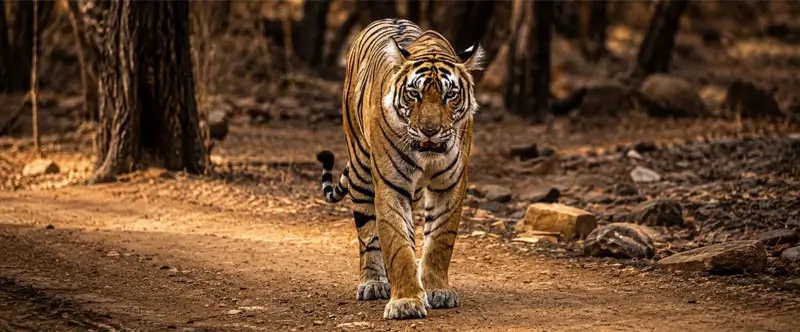
Tiger sightings cannot be guaranteed on any particular safari. One drive might include fresh pugmarks, alarm calls and no visual sighting. Another can produce a tiger crossing the road only minutes after entry.
The forest itself remains worth watching. Sambar deer, spotted deer, nilgai, wild boar, crocodiles, langurs and extensive birdlife are present, while leopards can occasionally be seen.
Ranthambore's lakes and historic stone structures give the reserve a visual character that goes beyond wildlife species alone. Photographers can return with strong images even when a tiger remains hidden.
For travellers coming from Lucknow, three nights near Ranthambore National Park provide enough time to recover from the journey and experience more than one part of the forest.
Make the journey worthwhile with a relaxing stay near Ranthambore National Park, where comfort, nature and authentic wildlife experiences come together beautifully.
Transport is only one part of the budget. Travellers should also account for accommodation, meals, safari permits, safari vehicle arrangements and local transfers.
A train-based trip will generally produce the lowest transport cost. A couple using reserved AC rail travel can reach Sawai Madhopur for a fraction of the price of a private road transfer.
Flying via Jaipur increases the budget because both airline tickets and the Jaipur-to-Ranthambore taxi need to be purchased. For a family of four, this can become a substantial amount.
A private taxi sits between convenience and cost. For several passengers travelling together, the per-person amount becomes more reasonable, particularly when the vehicle eliminates transfers at railway stations or airports.
Accommodation around Ranthambore ranges from modest stays to high-end wildlife resorts. Travellers seeking a comfortable experience should budget according to the location, room category and included meals rather than selecting a property only by its lowest displayed room rate.
Safari pricing also varies according to vehicle type, permit category and current official arrangements. Visitors should verify the actual amount at the time of reservation rather than depending on outdated online prices.
The journey from Lucknow becomes worthwhile when enough time is given to Ranthambore itself. Spending ten hours travelling, taking one safari and immediately beginning the return journey places too much pressure on a single forest drive.
A better Lucknow to Ranthambore wildlife trip uses the arrival day for travel and recovery, followed by at least two safari opportunities.
The contrast between the two destinations makes the journey memorable. Lucknow's architecture, food culture and urban atmosphere give way to Rajasthan's dry forest, lakes, rocky hills and wildlife tracks. The morning routine changes from city streets to listening for alarm calls from sambar and langurs.
A tiger encounter can be extraordinary, but it should not be treated as a guaranteed transaction. The reserve rewards patience. A quiet forest section can become active without warning, while an apparently promising area can remain silent for an entire drive.
Choose transport according to the complete journey rather than the lowest advertised price, arrive before the first safari day and give the forest enough time. Those decisions make the Lucknow to Ranthambore trip considerably more comfortable and far more rewarding.
The Lucknow to Ranthambore distance by road is approximately 580–630 kilometres, depending on the selected route and exact accommodation location.
A realistic private-car journey requires approximately 10–12 hours, including normal food and refreshment breaks.
Direct services to Sawai Madhopur Junction (SWM) may operate depending on the travel day and railway timetable. Other schedules may require a connection.
Suitable train services can take approximately 9–13 hours, while slower connections may require additional time.
Ranthambore has no regular commercial airport. A practical air route is to take a Lucknow to Jaipur flight and continue from Jaipur to Ranthambore by private car.
The journey generally requires around 3½–4½ hours, depending on traffic, road conditions and accommodation location.
A practical higher-side allowance is approximately ₹11,000–₹16,000 for a sedan and ₹15,000–₹22,000 or more for an SUV or MPV.
Yes. Lucknow–Agra–Ranthambore works well when the journey is divided across two days. Staying overnight in Agra is much more practical than squeezing sightseeing into a direct transfer day.
Two nights are workable, but three nights in Ranthambore provide better scope for multiple safari drives and enough rest after the long journey from Lucknow.
Train generally offers the best value, flying via Jaipur can reduce road fatigue, and a private Lucknow to Ranthambore taxi provides the greatest door-to-door convenience for families and groups.
Stay close to nature at Maa Ashapura Farm – a
boutique retreat near Ranthambore National Park.
Enjoy wildlife safaris, Marwari horse experiences, yoga, nature walks, and
private dining.