
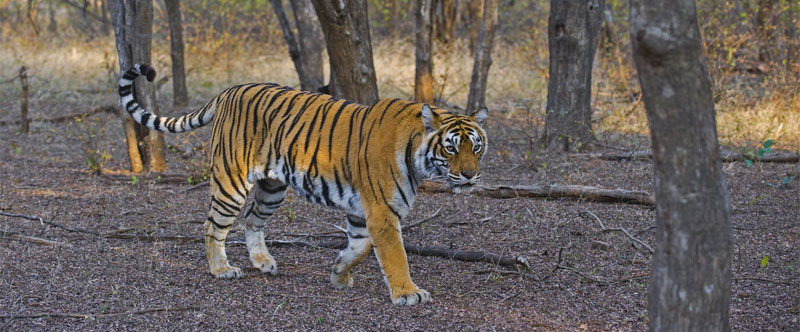
Jodhpur and Ranthambore show two strikingly different landscapes of Rajasthan. Jodhpur is dominated by Mehrangarh Fort, blue-painted neighbourhoods, sandstone architecture and the dry terrain of western Rajasthan. Ranthambore replaces the cityscape with forest tracks, rocky ridges, lakes, old ruins and tiger habitat around Sawai Madhopur.
The Jodhpur to Ranthambore distance by road is approximately 450 to 500 kilometres, depending on the route and the exact location of your accommodation. A realistic private-car journey usually requires around 8 to 10 hours after allowing for traffic, meals and slower road sections.
Rail can be a comfortable alternative. Travellers should search for services from Jodhpur Junction (JU) to Sawai Madhopur Junction (SWM), the principal railway station serving Ranthambore. Direct services may be available on selected schedules, while other journeys can require a connection. Train availability, operating days and timings should always be checked for the actual travel date.
A private taxi is useful for families and groups because it provides hotel-to-hotel transport. Rail is generally more economical for solo travellers and couples. Travellers with additional time can also break the road journey at places such as Ajmer or Pushkar, turning a long transfer into a broader Rajasthan itinerary.
The biggest mistake is treating the transfer as a short drive before a safari. Nearly 500 kilometres across Rajasthan deserves most of a day. Reaching Ranthambore the evening before the first Ranthambore tiger safari creates a far more comfortable wildlife trip.
The distance from Jodhpur to Ranthambore varies because there is no single hotel-to-hotel measurement.
A traveller leaving a property near Mehrangarh Fort may have a different starting distance from someone staying near Jodhpur Airport or the city's outer areas. At the destination, accommodation can be located in Sawai Madhopur town or farther toward the countryside surrounding Ranthambore.
For practical purposes, allow approximately 450–500 kilometres by road.
Driving time generally falls between 8 and 10 hours. Navigation may occasionally show a shorter estimate, but that figure usually assumes limited stopping and favourable traffic.
A proper intercity transfer should include at least one meal break and one shorter refreshment or washroom stop. Once those are added, the journey occupies most of the day.
Leaving early makes a substantial difference.
A departure around 6:00 AM allows travellers to cover a large section before midday. Under normal conditions, arrival during the mid-to-late afternoon is reasonable. The evening can then be used for check-in, dinner and rest.
Leaving at 9:00 or 10:00 AM may push arrival into the evening or night.
That becomes problematic when a morning safari is scheduled for the following day. Depending on season, a Ranthambore morning safari can require visitors to be ready around sunrise. A late arrival after nine hours on the road followed by an extremely early wake-up call is physically tiring.
An afternoon safari on the same day as the road transfer is generally not advisable.
Even if navigation suggests that it is technically possible, one traffic delay or longer meal stop can cause you to miss the reporting time. Forest safari permits operate within fixed shifts and should not be treated like flexible sightseeing tickets.
Leave behind the blue lanes, grand forts and dry landscapes of Jodhpur and journey towards a completely different side of Rajasthan.
The Jodhpur to Ranthambore road route crosses a substantial part of Rajasthan and can vary according to live navigation and road conditions.
A commonly practical corridor can take travellers from Jodhpur toward the Beawar–Ajmer–Kishangarh side, followed by roads heading east toward the Tonk/Sawai Madhopur region. Alternative routing can be recommended according to construction, traffic and the exact starting point.
Travellers should use live navigation immediately before departure rather than memorising an old highway sequence.
Ajmer is a useful geographical reference on this journey. Pushkar is also nearby, but neither destination should be treated as a ten-minute roadside stop if you genuinely want to see it.
Adding Pushkar between Jodhpur and Ranthambore can work well when an extra night is available. The town provides a natural break between western Rajasthan and the wildlife section of the itinerary.
Ajmer can similarly become an overnight or substantial daytime stop.
If the objective is simply to reach Ranthambore, keep stops functional rather than turning the transfer into a full sightseeing day.
A good road schedule could involve an early Jodhpur departure, breakfast after the first section, lunch around the middle of the journey and arrival at Ranthambore before evening.
Road quality is mixed over such a long distance. Major highway stretches can be comfortable, while regional sections may involve slower traffic, towns or construction.
During the monsoon, heavy rain can increase journey time. Winter mornings may also produce reduced visibility in some areas.
Self-driving travellers should check tyre condition, spare tyre, fuel, fluids and FASTag balance before departure. A nearly 500-kilometre journey is not the right time to discover that the spare tyre has no pressure.
Rail can be significantly less tiring than driving for eight or nine hours.
The stations to search are Jodhpur Junction (JU) and Sawai Madhopur Junction (SWM).
Direct railway services can operate on this corridor depending on the day and timetable. Other itineraries may involve a change at a suitable junction. Because Indian Railways schedules and operating days can change, travellers should verify current options before fixing accommodation or safari bookings.
Depending on the selected service, the Jodhpur to Sawai Madhopur train journey can require roughly 8 to 11 hours, with slower connections taking longer.
At first glance, this may not look faster than driving. The difference is comfort.
Passengers can rest, read, eat or sleep rather than spending the entire day in a car.
For an overnight service, reserved air-conditioned accommodation can be particularly practical. Travellers can leave Jodhpur, sleep during part of the journey and arrive closer to Ranthambore without sacrificing a complete sightseeing day.
Ticket fares vary by train and class.
As a broad practical range, Sleeper tickets may cost around ₹300–₹500, while AC 3 Tier can commonly fall around ₹800–₹1,300. AC 2 Tier may cost approximately ₹1,200–₹1,900 or more, while First AC and premium services can be considerably higher.
These figures are budgeting guidance rather than fixed railway fares.
Always check the live fare for the specific train, travel date, quota and class.
After arriving at Sawai Madhopur, travellers still need a road transfer to their accommodation. Arrange this in advance when arriving late at night or early in the morning.
A Jodhpur to Ranthambore taxi is the most convenient option for travellers who want direct transport without railway transfers.
The fare depends on vehicle category, operator policy, one-way billing, tolls and seasonal demand.
For a comfortable higher-side budget, a one-way sedan can be estimated at approximately ₹9,000–₹13,000. An SUV or MPV may cost around ₹12,000–₹18,000 or more.
Premium vehicles can exceed these figures substantially.
Before paying, ask for the complete price rather than only a per-kilometre quotation.
Confirm whether tolls, parking, state taxes and driver allowance are included. Some one-way taxi quotations may also account for the driver's or vehicle's return journey.
Vehicle size matters over eight to ten hours.
Two travellers with moderate luggage can use a sedan comfortably. Four adults with large suitcases should strongly consider an SUV or MPV.
Wildlife photographers may need additional space even with only two passengers because camera bags, tripods and long lenses occupy considerable room.
A private taxi also allows departure flexibility.
Travellers can leave immediately after breakfast, stop at a preferred restaurant and adjust breaks according to the group.
Families with children and elderly passengers often value this flexibility more than the price difference compared with rail.
Travellers with enough time can turn the Jodhpur to Ranthambore road trip into a more interesting Rajasthan route by dividing it across two days.
Pushkar is one of the strongest options.
Instead of driving almost 500 kilometres in one day, visitors can travel from Jodhpur to Pushkar, stay overnight and continue toward Ranthambore the next morning.
This creates shorter road sectors and provides time for Pushkar's lake area, temples, cafés and surrounding landscape.
Ajmer is another practical stop, particularly for travellers already interested in the city.
The important point is to add these destinations deliberately.
Stopping for several hours and still expecting to reach Ranthambore before an afternoon safari is a poor schedule.
If Pushkar or Ajmer is included, treat the journey as a two-day route.
For international visitors moving across Rajasthan, a sequence such as Jodhpur–Pushkar–Ranthambore–Jaipur can work efficiently because it reduces unnecessary backtracking.
Travellers with fewer days should travel directly and keep their time for Ranthambore.
Ranthambore's safari shifts change according to daylight.
Morning safaris generally begin between approximately 6:00 and 7:00 AM, depending on season. Afternoon entry can begin around 2:00 PM in shorter winter days and move later as daylight increases.
Visitors must follow the reporting time associated with the actual permit.
A forest drive generally occupies around three to three and a half hours.
This is why the arrival day matters.
After a Jodhpur to Ranthambore drive of eight to ten hours, taking an afternoon safari is unnecessarily stressful. Use the evening for recovery and enter the forest the next morning.
Ranthambore operates through multiple tourism zones, commonly identified as Zones 1 to 10. Safari vehicle arrangements generally involve smaller Gypsies and larger Canters, subject to current availability and forest rules.
Gypsies are attractive for photographers and smaller groups because there are fewer passengers. Canters offer a more economical option and can work well for larger groups.
Neither vehicle guarantees tiger sightings.
Tiger movement changes according to territory, water, prey, weather and natural behaviour. Booking multiple safari drives is therefore more sensible than depending on one outing.
After spending almost an entire day reaching Ranthambore, staying only one night gives poor value for the effort.
A minimum of two nights in Ranthambore is sensible. Three nights are much better for travellers whose main interest is wildlife.
With three nights, visitors can comfortably take two or three safari drives without filling every hour.
For example, arrive from Jodhpur during the afternoon and rest. Take a morning safari the following day and another drive that afternoon if desired. The next morning can include a third safari or a slower start.
Multiple drives matter because wildlife is unpredictable.
A first safari may produce an excellent tiger sighting. It may equally produce deer, crocodiles, birds and fresh tiger tracks without the tiger itself appearing.
The second drive begins with completely different conditions.
Temperature, light, animal movement and safari zone can all change.
This uncertainty is central to a genuine Ranthambore wildlife safari and should be treated as part of the experience rather than a problem to solve.
Jodhpur offers forts, architecture and the unmistakable character of western Rajasthan. Ranthambore brings forests, lakes, ruins and wildlife.
For a long road transfer, keep drinking water, basic snacks, identification documents, phone chargers and essential medication easily accessible.
Do not pack safari identification at the bottom of a suitcase. The document used for the reservation may need to be produced according to current permit rules.
Wildlife photographers should keep cameras and lenses in the passenger cabin rather than under heavy luggage.
For the safari itself, clothing depends on season.
Winter mornings can feel genuinely cold in an open vehicle. A jacket, layers and scarf can make the drive much more comfortable.
During warmer months, use breathable neutral clothing, a hat and sun protection. Dust can be substantial, so a light scarf and lens cloth are useful.
Binoculars are worth carrying even for visitors with cameras. They help with distant birds, leopards and animals across open areas.
Avoid loud music, shouting or anything that disturbs wildlife.
A tiger safari in Ranthambore is not a race to photograph one animal. Guides also read alarm calls, tracks and animal behaviour, and quieter visitors generally experience more of what is happening around them.
Jodhpur and Ranthambore complement each other because they offer almost opposite experiences.
In Jodhpur, the day may revolve around Mehrangarh Fort, markets, architecture and city viewpoints.
In Ranthambore, the day can begin before sunrise with a forest vehicle moving quietly through dry woodland while guides listen for deer alarm calls.
Combining both gives a Rajasthan itinerary much more variety than visiting a series of cities with similar sightseeing patterns.
After Ranthambore, Jaipur is a practical next destination for many travellers. Others continue toward Agra and Delhi.
A broader route can therefore follow Jodhpur–Ranthambore–Jaipur–Agra, or include Pushkar between Jodhpur and Ranthambore when additional time is available.
The long transfer should be respected rather than compressed.
Leave Jodhpur early, choose rail or road according to your comfort, arrive before the first safari day and give Ranthambore at least enough time for multiple forest drives.
The reward is a transition from one of Rajasthan's great fort cities to one of India's most distinctive tiger landscapes without needing to leave the state.
The Jodhpur to Ranthambore distance by road is approximately 450–500 kilometres, depending on the route and exact accommodation location.
Allow approximately 8–10 hours for a realistic private-car journey including normal breaks and traffic conditions.
Direct services may operate between Jodhpur Junction and Sawai Madhopur Junction depending on the travel day and railway timetable. Current availability should be checked before booking.
Sawai Madhopur Junction (SWM) is the principal railway station used by visitors travelling to Ranthambore National Park.
Suitable services can take roughly 8–11 hours, although the actual duration depends on the train and any required connection.
A practical higher-side budget is approximately ₹9,000–₹13,000 for a sedan and ₹12,000–₹18,000 or more for an SUV or MPV.
Yes. Jodhpur to Pushkar to Ranthambore works particularly well as a two-day road journey. Pushkar should be treated as a proper stop rather than squeezed into a direct transfer day.
It is not recommended. The road journey can require most of the day, and delays may cause you to miss the safari reporting time.
Two nights are workable, while three nights in Ranthambore provide better scope for multiple safaris and a less rushed wildlife stay.
Train is generally more economical and less physically tiring for solo travellers and couples. A private Jodhpur to Ranthambore taxi provides greater convenience for families, groups and travellers with substantial luggage.
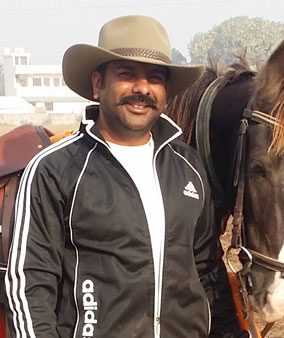
Stay close to nature at Maa Ashapura Farm – a
boutique retreat near Ranthambore National Park.
Enjoy wildlife safaris, Marwari horse experiences, yoga, nature walks, and
private dining.