
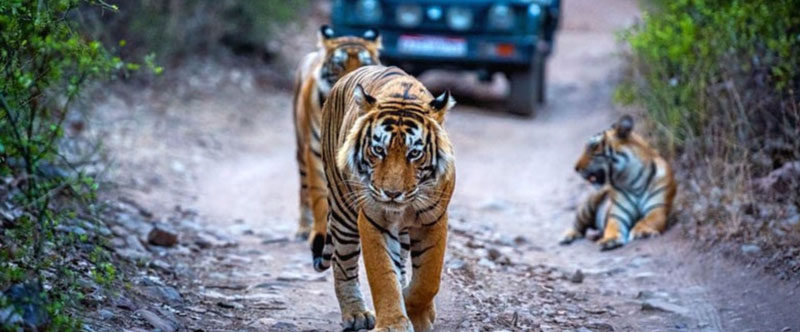
Travelling from Chandigarh to Ranthambore takes you from the broad avenues and organised urban landscape of Chandigarh to the dry forests, rocky ridges, lakes and historic ruins surrounding Ranthambore National Park. The journey is long enough to require a sensible transport choice, but it remains practical for a multi-night wildlife break without turning the trip into a complicated multi-city itinerary.
The Chandigarh to Ranthambore distance by road is approximately 560 to 620 kilometres, depending on the route, current traffic and the exact location of your accommodation around Sawai Madhopur. A realistic road journey generally requires around 10 to 12 hours once NCR traffic, meal breaks and regional road sections are taken into account. This makes an early departure particularly important for travellers driving or hiring a private taxi.
Train travel can be considerably more comfortable for visitors who do not want to spend most of the day inside a car. The railway destination for Ranthambore is Sawai Madhopur Junction (SWM). Direct services from Chandigarh may be available on selected schedules, while other journeys can involve a change in Delhi or another suitable railway junction. Actual operating days and timings should be checked before safari permits are linked to a specific arrival.
Flying is another possibility, but Ranthambore does not have a regular commercial airport. Air travellers generally use Jaipur International Airport and continue to Sawai Madhopur by road. A flight can reduce the longest continuous travel section, although airport reporting, baggage collection and the Jaipur-to-Ranthambore drive mean the complete journey still takes several hours.
For most visitors, the first safari should be scheduled for the morning after arrival. The Chandigarh to Ranthambore journey is too long to gamble a valuable forest permit against traffic, railway delays or flight disruption.
The distance from Chandigarh to Ranthambore is best considered within the 560–620 kilometre range because the exact figure depends on where the journey begins and which highway combination is used. A traveller starting near Chandigarh Airport may receive a different distance from someone leaving from northern Chandigarh, Panchkula or Mohali. At the destination, hotels and wildlife properties are spread across Sawai Madhopur and the surrounding Ranthambore tourism area, so the final road distance can vary further.
For a private car, approximately 10–12 hours is a realistic driving allowance. A navigation application may show a shorter figure under ideal traffic conditions, but a leisure trip should include time for breakfast, another meal, fuel and washroom breaks. The Delhi NCR portion can also create unpredictable delays, especially around busy weekday periods and long weekends.
Leaving Chandigarh around 5:00 AM can make the journey considerably easier. An early departure allows several hundred kilometres to be completed before the busiest part of the day and provides a useful margin for traffic. A traveller leaving after 8:00 or 9:00 AM risks reaching Ranthambore late in the evening.
That difference matters when a Ranthambore morning safari is booked for the following day. Forest drives can begin around sunrise, which means visitors may need to wake very early. Reaching the accommodation at 10:00 PM after eleven hours on the road, eating dinner and waking a few hours later is physically demanding.
A same-day afternoon safari should generally be avoided. Even if the shortest navigation estimate appears to leave enough time, a single traffic jam near Delhi NCR can remove that margin. Safari reporting times are fixed, and road delays do not provide automatic entitlement to a later forest entry.
The return journey deserves similar attention. If the final morning includes a safari, allow enough time afterward for breakfast and rest before beginning another long road transfer toward Chandigarh.
After a long journey through Rajasthan, settle into a peaceful retreat where nature, comfort and unforgettable wildlife experiences come together. Stay longer, slow down and discover Ranthambore beyond the journey.
The Chandigarh to Ranthambore road route generally moves south through Haryana and the Delhi NCR region before continuing toward eastern Rajasthan. Depending on current traffic, navigation may direct travellers through corridors associated with Delhi, Gurugram, Sohna, Dausa and Sawai Madhopur, while alternative routes through the broader Jaipur side may appear when conditions make them preferable.
The expansion of major expressway corridors has improved parts of this journey, but travellers should still check live navigation immediately before departure. Highway construction, diversions and congestion can change the strongest route.
The Delhi NCR section deserves particular attention. Crossing the region at peak traffic time can add a substantial delay. An early Chandigarh departure helps travellers reach this section before the heaviest daytime congestion.
For a direct journey, stops should remain practical. One breakfast stop after the initial driving section and another meal or tea break later in the day are normally enough. Turning the transfer into a sightseeing day makes arrival unpredictable.
If travellers want to add Jaipur, it should be treated as a proper destination with at least one night rather than a short roadside diversion. A Chandigarh–Jaipur–Ranthambore itinerary can work very well when enough days are available because it divides the long road journey and adds one of Rajasthan's major cities.
Self-driving visitors should check tyre pressure, spare tyre condition, engine fluids, brakes, FASTag balance and fuel before departure. On a journey exceeding 500 kilometres, minor mechanical neglect can create major disruption.
Drivers should also rotate where possible. Smooth expressway driving can feel easy but still causes fatigue after several continuous hours. A twenty-minute break is better than attempting to protect an unrealistic arrival estimate.
Rail can be one of the most comfortable choices for this route, particularly when a well-timed service is available. The railway destination is Sawai Madhopur Junction, station code SWM.
Travellers should search for trains from Chandigarh Railway Station (CDG) to Sawai Madhopur. Depending on the timetable and day, a direct service may be available, while other options can involve changing trains in Delhi or another suitable junction.
The journey duration varies substantially according to the train. A suitable Chandigarh to Sawai Madhopur train can require approximately 10 to 14 hours, while connections and slower services may take longer.
This may not appear significantly faster than driving, but the comfort difference can be substantial. On a train, passengers can move, eat, read and sleep rather than spending almost the entire day seated in a road vehicle.
An overnight railway service is especially useful when the timing works. It can save daytime hours and allow visitors to arrive with less road fatigue.
For this distance, AC 3 Tier offers a practical combination of comfort and price. AC 2 Tier is better for travellers wanting additional space and fewer passengers in the compartment. Sleeper can reduce costs for budget-conscious travellers.
Indicative fares can vary from approximately ₹400–₹700 for Sleeper, around ₹1,000–₹1,700 for AC 3 Tier, and roughly ₹1,500–₹2,500 or more for AC 2 Tier. Premium services and First AC can cost substantially more.
These figures should be used only for budgeting. Actual railway fares depend on the service, quota and booking conditions.
After arrival, travellers need transportation from Sawai Madhopur Railway Station to their Ranthambore accommodation. Properties can be located several kilometres from the station, so a pickup should be arranged in advance for late-night or early-morning arrivals.
There is no regular commercial airport at Ranthambore, so air travel requires a road connection from another city. Jaipur International Airport is the most practical major airport for this route.
When a suitable Chandigarh to Jaipur flight is operating, the flight itself can take approximately 1½ hours. However, travellers should compare door-to-door time rather than only airborne duration.
A passenger must reach Chandigarh Airport, report well before departure, complete security, board the aircraft, collect luggage in Jaipur and then continue by private vehicle toward Ranthambore.
The Jaipur to Ranthambore road distance is approximately 170–190 kilometres, depending on the exact destination. A practical road transfer takes around 3½–4½ hours.
Once the airport stages are included, the complete journey can require approximately 7–9 hours, assuming the flight timing is convenient and there are no significant delays.
Airfares vary considerably. A one-way Chandigarh-to-Jaipur economy ticket may sometimes cost approximately ₹4,000–₹7,000, while holiday periods, weekends and short-notice travel can push the fare toward ₹8,000–₹13,000 or more.
A private Jaipur Airport to Ranthambore sedan can cost approximately ₹4,500–₹7,000, while an SUV or MPV can be budgeted around ₹6,000–₹9,000 or more.
For one traveller, this combination can be considerably more expensive than rail. For families or visitors prioritising comfort, the shorter continuous travel sections can justify the additional cost.
A Chandigarh to Ranthambore taxi provides complete door-to-door convenience but involves a long road journey. The vehicle can collect travellers directly from Chandigarh, Mohali or Panchkula and take them to their accommodation without station or airport transfers.
For a one-way journey, a sensible higher-side budget for a sedan is approximately ₹11,000–₹16,000. A larger SUV or MPV can reasonably cost around ₹15,000–₹22,000 or more, depending on vehicle type, operator policy and seasonal demand.
The final quotation should clearly state whether tolls, state taxes, parking and driver allowance are included. Some operators calculate return kilometres even when passengers only require a one-way transfer, while specialised one-way taxi providers may use a different pricing structure.
Vehicle comfort is important on a ten-hour journey. Two passengers with standard luggage can use a sedan comfortably, while four adults should generally select an SUV or MPV.
Families with children often find a private vehicle worthwhile because they can stop whenever necessary. Travellers with elderly passengers receive the same advantage.
Wildlife photographers should account for camera equipment when selecting the vehicle. A group of three people with large lenses and several camera bags may require more luggage space than four ordinary tourists.
A taxi becomes more financially attractive when three or four passengers share the cost. The per-person difference compared with premium railway classes or flight-plus-road arrangements can become much smaller.
Jaipur can fit naturally into a Chandigarh to Ranthambore road trip when the itinerary has enough days. Rather than driving the entire distance in one stretch, travellers can stay in Jaipur and continue to Ranthambore the following day.
This arrangement works particularly well for first-time Rajasthan visitors. Jaipur deserves proper time for its forts, palaces, markets and old-city architecture, so it should not be treated as a brief lunch stop.
A practical sequence can be Chandigarh–Jaipur–Ranthambore, followed by Agra or Delhi depending on the onward route. This reduces the pressure of one extremely long road day.
Travellers flying to Jaipur can use the same structure. Instead of landing and immediately spending four hours in a taxi, they can stay overnight in Jaipur and continue the next morning.
The alternative is to travel directly when wildlife is the main priority. In that case, reach Ranthambore first and give the saved day to an additional safari.
The correct choice depends on the trip's purpose. A traveller primarily interested in tiger photography will gain more from another forest drive, while a first-time visitor to Rajasthan may value Jaipur equally.
Ranthambore generally operates morning and afternoon forest shifts, with entry times adjusted according to daylight. During cooler periods, morning drives may begin around 7:00 AM, while schedules can move toward approximately 6:00 AM as sunrise becomes earlier. Afternoon drives can begin around 2:00 PM during shorter winter days and shift toward approximately 3:30 PM when daylight lasts longer.
The exact timing on the safari permit should always take priority over general schedules.
A normal Ranthambore National Park safari lasts around three to three and a half hours. Visitors enter designated tourism routes in authorised vehicles, generally smaller Gypsies or larger Canters depending on current allocation and permit availability.
A Gypsy safari in Ranthambore is particularly attractive for wildlife photographers and smaller groups because fewer passengers provide more room for equipment and viewing. Canters can offer a more economical option and still travel through designated safari routes.
Neither a particular vehicle nor a specific zone can guarantee a tiger sighting. Ranthambore's tigers move naturally according to territory, prey, water availability and weather.
Visitors travelling all the way from Chandigarh should therefore consider booking more than one safari. Two or three forest drives provide different lighting, wildlife activity and potentially different tourism zones.
A one-night visit makes little sense after travelling more than 500 kilometres.
At least two nights in Ranthambore should be kept for a short wildlife break, while three nights provide a far more comfortable schedule. The arrival evening can remain completely free, allowing travellers to eat properly and sleep before the first safari.
The following morning can be used for a forest drive, with another safari that afternoon when permits are available. A third drive can be taken the next morning before departure.
This structure also reduces pressure around tiger sightings. A tiger may appear during the first safari, but there is no guarantee. One drive may produce only pugmarks and alarm calls, while the next can produce an extended sighting.
The reserve is also home to sambar deer, spotted deer, nilgai, wild boar, crocodiles, langurs, leopards and numerous bird species. The lakes, rocky ridges and old stone structures add significant visual character.
Wildlife photographers benefit particularly from multiple drives because changing light can transform the same forest landscape. Morning mist, harsh midday contrast and warm late-afternoon light create completely different photographic conditions.
For visitors travelling from Chandigarh, three nights provide enough time to experience these changes without feeling that the entire stay depends on one safari.
Whether you travel from Chandigarh by road, rail or via Jaipur, make your arrival count with a tranquil retreat designed for comfort, relaxation and meaningful wildlife experiences.
The total Chandigarh to Ranthambore trip cost depends heavily on transport choice.
Rail is normally the most economical option for solo travellers and couples. Even an air-conditioned reserved berth can cost much less than a private road transfer.
A private taxi becomes more competitive for groups because the cost is shared. Four adults dividing an SUV fare may find the additional convenience worthwhile.
Flying via Jaipur is generally the most expensive transport combination once airline tickets and the final road transfer are included. It is primarily valuable for travellers who prioritise comfort or have limited tolerance for a long road or rail journey.
Accommodation is another major variable. Ranthambore has everything from straightforward stays around Sawai Madhopur to premium wildlife resorts. Visitors should compare location, meals and safari-transfer arrangements rather than judging a property solely by room price.
Safari expenses also need to be added separately according to the permit and vehicle category available. Rates and procedures can change, so current booking information should be checked when the forest drive is reserved.
A realistic budget should therefore include transportation, hotel nights, meals, local transfers and at least two safari drives.
A long-distance wildlife trip works best when the journey does not consume all the traveller's energy. Whether arriving by train, road or a flight through Jaipur, the evening before the first safari should remain relatively quiet.
Keep the identification document associated with the safari reservation accessible rather than packed deep inside a suitcase. Confirm the following morning's pickup or reporting arrangement before going to sleep.
Winter safari mornings can be surprisingly cold in an open vehicle. Layers, a jacket and a scarf can make a major difference. During warmer periods, breathable clothing, a hat, sunglasses and sun protection are more useful.
Ranthambore can also be dusty, so photographers should carry a lens cloth and protect sensitive equipment when the vehicle travels over dry tracks.
Binoculars are useful even for visitors carrying cameras. Many rewarding observations occur at a distance, especially birds, leopards and animals moving on rocky slopes.
The Chandigarh to Ranthambore journey requires a full day's commitment, but the contrast makes it worthwhile. City roads and long highways eventually give way to forest tracks where the pace is determined by animal movement rather than traffic. Giving that transition enough time is what turns a long transfer into a rewarding wildlife break.
The Chandigarh to Ranthambore distance by road is approximately 560–620 kilometres, depending on the selected route and exact accommodation location.
A realistic private-car journey takes around 10–12 hours, including normal meal and refreshment breaks.
Direct services to Sawai Madhopur Junction may be available depending on the railway schedule and travel day. Other options can involve a change at Delhi or another junction.
Suitable railway journeys can take approximately 10–14 hours, while slower services or connections may require additional time.
Ranthambore does not have a regular commercial airport. Travellers can take a Chandigarh to Jaipur flight and continue from Jaipur to Ranthambore by road.
The road transfer generally takes around 3½–4½ hours, depending on traffic and the exact hotel location.
A practical higher-side budget is around ₹11,000–₹16,000 for a sedan and approximately ₹15,000–₹22,000 or more for an SUV or MPV.
Yes. A Chandigarh–Jaipur–Ranthambore itinerary works well when enough time is available and avoids completing the entire road journey in one day.
Two nights are workable, while three nights in Ranthambore provide better scope for multiple safari drives and enough rest after the long journey.
Train generally provides the strongest value, flying via Jaipur reduces continuous travel fatigue, and a private Chandigarh to Ranthambore taxi offers the greatest door-to-door convenience for families and groups.
Stay close to nature at Maa Ashapura Farm – a
boutique retreat near Ranthambore National Park.
Enjoy wildlife safaris, Marwari horse experiences, yoga, nature walks, and
private dining.