
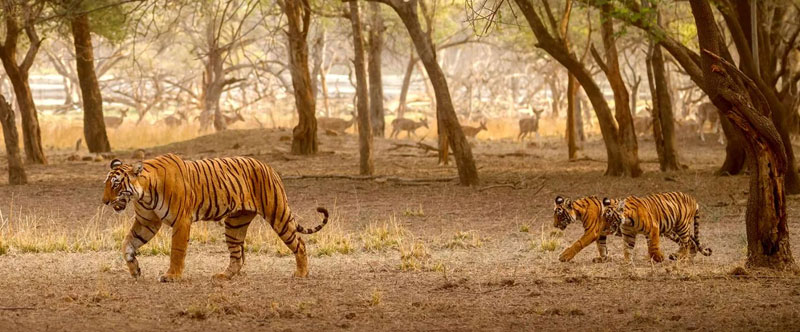
Travelling from Ahmedabad to Ranthambore connects one of Gujarat's largest cities with one of Rajasthan's most recognised wildlife destinations. The journey is considerably longer than routes from Jaipur, Kota or Agra, so the transport decision has a direct impact on how much time and energy remain for the actual wildlife stay. A road journey offers complete flexibility, trains can provide excellent value and overnight comfort, while flying can be useful for travellers who are prepared to combine an airport journey with a substantial road transfer.
The Ahmedabad to Ranthambore distance by road is approximately 650 to 700 kilometres, depending on the selected route, the starting point in Ahmedabad and the exact accommodation location around Sawai Madhopur. A realistic road journey generally requires around 11 to 13 hours, including normal breaks and slower sections. Attempting to complete the drive and immediately enter Ranthambore National Park for a safari is not sensible. The transfer itself deserves a full day.
For many travellers, the train is the strongest option because Sawai Madhopur Railway Station (SWM) is directly connected to India's major railway network. Several long-distance services travelling between Gujarat and North India use the Rajasthan corridor, although direct availability, departure times and operating days need to be checked for the actual travel date. An overnight train can be particularly useful because it converts a long transfer into rest time.
There is no commercial airport at Ranthambore itself. Travellers considering an Ahmedabad to Ranthambore flight generally need to fly to Jaipur and continue by road to Sawai Madhopur and Ranthambore. This can reduce physical fatigue, but airport reporting, baggage collection and the Jaipur-to-Ranthambore road transfer must be included when comparing total journey time.
The road distance between Ahmedabad and Ranthambore is substantial. Travellers should allow approximately 650–700 kilometres rather than relying on a single figure because road routing can change according to traffic, highway conditions and the final hotel location. A navigation application may occasionally suggest a journey close to ten or eleven hours, but such estimates usually assume continuous movement with limited stopping. A practical family or leisure transfer is closer to 11–13 hours.
The starting point within Ahmedabad can also add time. A traveller leaving from the SG Highway side, the airport area or central Ahmedabad may need a significant period simply to clear urban traffic. The same applies on arrival because reaching Sawai Madhopur town does not necessarily mean reaching the accommodation. Resorts, hotels and farm stays around Ranthambore are distributed across different roads outside the railway station area.
An early departure is essential for anyone travelling by car. Leaving Ahmedabad around 5:00 or 5:30 AM provides a much better chance of reaching Ranthambore before evening. It also allows a large section of the journey to be completed before midday heat becomes intense. One proper breakfast stop and another meal or refreshment break are reasonable on a journey of this length. Trying to drive almost 700 kilometres with minimal rest is neither comfortable nor advisable.
The long Ahmedabad to Ranthambore travel time also means the first safari should normally be scheduled for the following day. Ranthambore operates fixed morning and afternoon forest shifts. If a vehicle reaches the area later than expected because of traffic or roadworks, a prepaid safari permit cannot simply be shifted by an hour. Arriving during the afternoon, checking in, eating properly and sleeping before a morning safari produces a far better experience.
Travellers returning to Ahmedabad should apply the same logic. A morning safari followed by an immediate eleven-hour drive creates an exhausting day. Staying the night after the final safari or breaking the return journey can make the trip considerably safer and more enjoyable.
Travelling from Ahmedabad to Ranthambore takes planning — and the right place to pause matters. Stay close to the national park at Maa Ashapura Farm, where wildlife safaris, nature walks.
The Ahmedabad to Ranthambore road route crosses a large part of Rajasthan, and several route combinations may appear on navigation applications. Depending on live conditions, travellers can be directed through corridors associated with Udaipur, Chittorgarh, Kota and the Sawai Madhopur side, while alternative highway combinations may be recommended when they provide better travel time.
The exact route should be checked shortly before departure rather than copied permanently from an older travel article. Rajasthan has seen substantial highway development, and construction, diversions and local conditions can change which road is preferable. A route that is fastest during one season may not remain the strongest choice several months later.
A journey through the Udaipur–Chittorgarh–Kota corridor can also be attractive for travellers who have additional time because each region offers worthwhile stops. However, these destinations should not be squeezed into a direct transfer day. Visiting Udaipur properly requires at least an overnight stay, while Chittorgarh Fort itself can take several hours. A direct Ahmedabad-to-Ranthambore traveller should use stops primarily for meals and rest.
Vehicle condition matters greatly on this route. Tyres, spare tyre pressure, engine fluids, brakes and air conditioning should be checked before leaving. A breakdown hundreds of kilometres from Ahmedabad can easily remove an entire day from the itinerary. FASTag balance and sufficient fuel should also be arranged in advance.
Families using their own car should share driving where possible. Long smooth highway sections can create fatigue even when traffic is light. A short break every few hours is more effective than relying on coffee while continuing to drive. Visitors who do not regularly undertake long-distance road trips may find a professional driver more comfortable.
During hotter months, the afternoon temperature can become demanding, particularly on exposed highway stretches. During monsoon periods, heavy rainfall can slow sections of the journey. Winter offers more comfortable daytime temperatures, although early morning visibility can occasionally be reduced. These conditions are another reason to treat Ahmedabad to Ranthambore by road as a full travel day.
For many visitors, rail offers the best balance between price, comfort and total effort. The railway destination for Ranthambore is Sawai Madhopur Junction (SWM). Travellers should search for services from Ahmedabad Junction (ADI) and other relevant Ahmedabad-area boarding stations according to the selected train.
Direct trains may be available on the corridor depending on the travel date, while additional options can involve connections. Because railway schedules and operating days can change, current Indian Railways information should always be checked before accommodation and safari arrangements are made non-refundable.
A suitable Ahmedabad to Sawai Madhopur train can generally require around 10 to 14 hours, depending on the service. Faster long-distance trains may complete the journey closer to the lower end of that range, while slower services can take longer. The advantage is that passengers do not need to spend the entire period sitting in a road vehicle.
An overnight train is especially practical. Travellers can board in Ahmedabad during the evening, sleep for a substantial part of the journey and arrive in Rajasthan with most of the transfer completed. Reserved air-conditioned classes are worth considering for this distance. AC 3 Tier provides a useful balance between cost and comfort, while AC 2 Tier offers more space and fewer passengers per compartment.
Indicative fares vary by service, quota and class. Sleeper tickets can commonly fall in the approximate ₹400–₹700 range, while AC 3 Tier may cost around ₹1,000–₹1,700. AC 2 Tier can fall around ₹1,500–₹2,400 or more, and First AC or premium services can cost considerably more. These amounts are budgeting estimates rather than permanent fares, and live railway pricing should be checked for the actual date.
After reaching Sawai Madhopur, visitors still need transportation to their accommodation. The Sawai Madhopur station to Ranthambore hotel transfer may take anywhere from a short drive to considerably longer depending on the property's location. Visitors arriving late at night or early in the morning should arrange pickup before boarding the train.
There is no airport at Ranthambore National Park or Sawai Madhopur offering regular commercial flights, so an air journey requires a combination of flight and road transport. For most travellers, Jaipur International Airport is the practical aviation gateway.
A direct Ahmedabad to Jaipur flight, when available at a suitable time, generally spends roughly 1½ hours in the air. However, flight duration alone gives a misleading picture of the complete journey. Travellers need to reach Ahmedabad airport, arrive well before departure, complete security procedures, collect luggage in Jaipur and then continue by road.
The Jaipur to Ranthambore distance by road is approximately 170–190 kilometres depending on the route and hotel location, with a practical driving time of around 3½ to 4½ hours.
This means a flight itinerary can still consume seven or eight hours door to door once all stages are included. It can nevertheless be much less tiring than driving directly from Ahmedabad for twelve hours.
Airfares fluctuate significantly. A one-way Ahmedabad-to-Jaipur economy ticket may sometimes be available around ₹3,500–₹6,000, while short-notice travel, weekends and holiday periods can push fares toward ₹7,000–₹12,000 or considerably higher. Baggage selection and airline fare category also affect the total.
The road transfer from Jaipur Airport adds another expense. A private sedan to Ranthambore can reasonably be budgeted on the higher side around ₹4,500–₹7,000, while a larger SUV may cost approximately ₹6,000–₹9,000 or more, depending on operator and inclusions.
For a solo traveller, train travel can therefore be dramatically cheaper. For a family seeking comfort and short on time, flying to Jaipur and continuing by private car can be worth the additional expense.
Hiring a private taxi from Ahmedabad to Ranthambore provides maximum convenience but is a substantial road journey for both passengers and driver. The vehicle collects travellers from their home, hotel or airport and travels directly to the accommodation around Sawai Madhopur.
For a one-way transfer, a practical higher-side allowance for a sedan is approximately ₹12,000–₹17,000. A larger SUV or MPV can reasonably cost around ₹16,000–₹23,000 or more. Premium vehicles may be considerably higher.
Taxi quotations should always be checked for inclusions. Ask whether tolls, state taxes, parking and driver allowance are included and whether the operator calculates return kilometres. Some one-way taxi providers use different pricing models from traditional round-trip operators, so comparing only the advertised per-kilometre rate can be misleading.
Vehicle selection becomes particularly important on a journey approaching twelve hours. Two passengers can travel comfortably in a good sedan, but four adults with large luggage should use an SUV or MPV. Photographers carrying camera bodies, long telephoto lenses and hard cases also benefit from the additional space.
For families, the main advantage is control. Breaks can be taken when needed, departure can be set around home convenience and there is no luggage transfer between stations or airports. The disadvantage is fatigue. Even in a comfortable vehicle, sitting for most of a day is demanding.
A private taxi makes more sense when Ranthambore is part of a wider road itinerary. Travellers continuing through Rajasthan can use a multi-day vehicle rather than paying for separate point-to-point transfers.
For a solo traveller, the Ahmedabad to Ranthambore train will usually offer the strongest financial value. A reserved AC ticket can cost a fraction of either a private taxi or flight-plus-road combination, and an overnight service can preserve daytime hours.
Couples can also find rail attractive, particularly when a direct service matches their dates. The total cost remains manageable, and there is no need for an eleven-hour road journey.
Families should compare more carefully. Four AC railway tickets, station transfers and luggage handling can narrow the gap between rail and a private car. A family with young children may place greater value on door-to-door transport.
Flying via Jaipur is strongest when time and physical comfort matter more than price. The journey is not as short as the flight duration suggests, but avoiding 650–700 kilometres of continuous road travel can be valuable.
A self-drive journey is attractive for people who enjoy long road trips and want their own vehicle at the destination. It also works well when the itinerary includes Udaipur, Chittorgarh, Kota or other Rajasthan stops.
The correct comparison should include the entire Ahmedabad to Ranthambore travel cost, not merely one ticket. Add home-to-station or airport transfers, meals, tolls, fuel, final hotel transfers and the value of the time consumed.
Leave the pace of Ahmedabad behind and enter a very different Rajasthan. Whether your route brings you through the railway network, Jaipur or the open road.
Ranthambore safaris operate in morning and afternoon shifts, with timings adjusted according to seasonal daylight. Morning entry can be around 7:00 AM during colder periods and move closer to 6:00 AM as sunrise becomes earlier. Afternoon drives may begin around 2:00 PM during shorter winter days and shift toward approximately 3:30 PM during periods with longer daylight.
The actual reporting time associated with the permit always takes priority over general timing information. A typical forest drive occupies around three to three and a half hours.
After travelling from Ahmedabad, visitors should ideally spend the night in Ranthambore before their first safari. This is particularly important after a full road journey. Entering an open safari vehicle after twelve hours in a car rarely produces the best first impression of the reserve.
Ranthambore tourism operates across multiple safari zones, commonly known as Zones 1 to 10, and visitors generally enter in smaller Gypsy vehicles or larger Canters according to current permit allocation. A Gypsy is often preferred by photographers because the smaller group provides greater freedom with long lenses, while a Canter can offer a more economical safari.
Neither vehicle nor zone guarantees a tiger sighting. A Ranthambore tiger safari takes place in a natural forest where animal movement depends on territory, water, prey, weather and many other factors. Visitors staying long enough for two or three drives generally receive a much fuller wildlife experience than those relying on a single safari.
The length of the journey makes a one-night visit poor value. Travellers have already invested ten or more hours reaching Ranthambore, so the destination deserves enough time to justify the transfer.
At least two nights in Ranthambore should be considered, while three nights provide a much better rhythm. Arrive during the afternoon or evening, sleep properly and take a morning safari the following day. A second safari can be booked that afternoon, followed by another drive the next morning when permits and budget allow.
Multiple drives also reduce the pressure surrounding tiger sightings. Ranthambore contains sambar deer, spotted deer, nilgai, wild boar, crocodiles, langurs, leopards and extensive birdlife alongside its tigers. The landscape itself is highly distinctive, combining lakes, dry woodland, rocky ridges and historical structures.
Visitors interested in photography should allow enough time to appreciate this broader environment. A tiger beside a lake may be the headline moment, but a sambar standing in early morning light or a crocodile resting beside water can produce equally memorable photographs.
For travellers coming all the way from Gujarat, three nights near Ranthambore National Park provide a far better return on the journey than arriving, taking one safari and immediately beginning the long trip home.
A road traveller can leave Ahmedabad before sunrise and reach Ranthambore during the late afternoon or evening. The first night should remain free. After dinner and adequate sleep, the following morning can begin with the first safari. The afternoon can be used for rest or a second forest drive.
Rail travellers can use an overnight service when available and reach Sawai Madhopur the following day. If the train arrives early enough, the day can remain relaxed rather than immediately committing to a safari. This protects the itinerary against railway delays.
Air travellers can fly to Jaipur and continue by private vehicle. Even when the flight is early, keeping the first safari for the next morning avoids stress caused by flight delays, baggage collection or road traffic.
After Ranthambore, visitors do not necessarily need to return directly to Ahmedabad. Jaipur, Udaipur and other Rajasthan destinations can be added according to the broader route. This can make the long northbound journey much more rewarding.
Whatever transport is selected, the strongest Ahmedabad to Ranthambore trip gives travel and wildlife separate space. The journey gets you to tiger country; the following days should be left for the forest rather than spent recovering from an unnecessarily compressed schedule.
The Ahmedabad to Ranthambore distance by road is approximately 650–700 kilometres, depending on the selected route and exact accommodation location.
A realistic road journey requires approximately 11–13 hours, including normal meal and refreshment breaks.
Direct services to Sawai Madhopur Junction may be available depending on the travel date and timetable. Travellers should check current Indian Railways schedules before booking.
Suitable railway services can generally require around 10–14 hours, although individual trains may be faster or slower.
Ranthambore does not have a regular commercial airport. Travellers can fly from Ahmedabad to Jaipur and continue approximately 170–190 kilometres by road to Ranthambore.
A practical higher-side budget is approximately ₹12,000–₹17,000 for a sedan and ₹16,000–₹23,000 or more for an SUV or MPV for a one-way private transfer.
Train is usually considerably more economical, especially for solo travellers and couples. Flying via Jaipur can reduce road fatigue and is useful when comfort and available time matter more than cost.
It is not recommended. The road journey can take most of the day, and any delay can cause the safari reporting time to be missed. Taking the first safari the following morning is safer.
Two nights are workable, while three nights in Ranthambore provide better scope for multiple safari drives and make the long journey from Ahmedabad more worthwhile.
Sawai Madhopur Junction (SWM) is the main railway station for travellers visiting Ranthambore National Park, with onward road transfers available to accommodation around the tourism area.
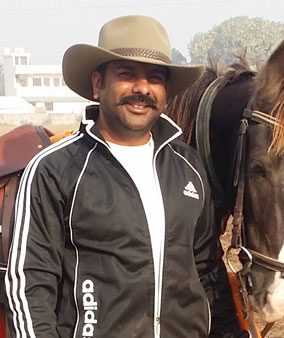
Stay close to nature at Maa Ashapura Farm – a
boutique retreat near Ranthambore National Park.
Enjoy wildlife safaris, Marwari horse experiences, yoga, nature walks, and
private dining.